

For years, Matt Levine has argued that “eventually, every possible trade will be packaged into an exchange-traded fund.” This past week, on the back of Robinhood’s launch of an agentic trading account, he revised himself:
But now I think that this argument was naïve, and the ETF, as a universal package for trade ideas, might already be outdated. “Every possible trade” will be an ETF? There are infinite possible trades, some of which ETF providers and brokers and wealth advisers have probably never thought of… What you want is a more general-purpose technology, a way to describe any imaginable trade in a few sentences and then execute it with a click of a button. And that, increasingly, exists.
He’s right. The agentic broker is the natural successor to the ETF. Any trade you can describe, you can now execute. Robinhood’s own examples make that concrete:
A thematic investor with conviction in AI or semiconductors can have an agent build an initial portfolio matching their criteria, monitor the space for new entrants and analyst upgrades, and rebalance toward the strongest opportunities at a regular cadence. An active trader can backtest a mean reversion strategy to see how it performed historically, and deploy it to automatically buy oversold stocks and sell when they revert to the mean.
Robinhood’s VP for brokerage, Abhishek Fatehpuria, told Bloomberg that “when we enable customers to connect their outside agents and outside tools, the possibilities are pretty vast.” That is exactly the right adjective. They are vast. And that vastness is the part most people are not yet thinking carefully about.
Because the question Levine’s framing leaves open is the one that actually matters: where does the trade idea come from? Levine himself is uneasy about the answer. In the same piece, he writes:
Stock trades are not really free, and anyone who works in professional quantitative trading was horrified by [the suggestion that they are]. Presumably these agents will be good for business at the electronic market makers who fill Robinhood’s orders and collect a spread on each trade. “Agentic trading,” to them, means something like “retail traders making lots of small predictable rule-based stock trades all the time,” which is what they want.
And then, the line that is really the heart of the matter:
One possibility is that widespread agentic retail investing would allow each individual investor to automate his or her idiosyncratic investing ideas, leading to, you know, a lot of random noise trading. Another possibility is that widespread agentic retail investing would lead to all the individual investors automating the same, like, 20 investing ideas, leading to herding and predictability.
The first possibility suggests that AI will have no edge at all in trading, but the second possibility is the one we should worry even more about, and it is, with overwhelming probability, the one that plays out by default.
Every general-purpose AI chatbot, asked some version of what should I buy, is going to lean on the same training distribution of financial commentary, the same surface of recent headlines, the same set of well-known names. The defaults are convergent. The agents on top of those defaults are not going to disagree with each other in any interesting way, because they were not given any interesting way to disagree.
You don’t get edge from running a customized strategy on top of a generic input pipeline; you get a slightly different rendering of the same twenty trades that every other agent is also lining up to make. That isn’t investing. It is a slower, politer version of the meme-stock cycle, automated and rebalanced quarterly, with a market-making industry happy to collect the spread on each lap.
The conversation has to move past the agent itself and back onto what it reads. And that begins with being honest about what today’s AI is, and is not, capable of.
Today’s AI is not yet capable of financial creativity. It cannot originate a thesis the way Citrini does in Let There Be Light, identifying an optical-interconnect market structure shift years before it reaches headlines. It cannot do what Druckenmiller does when he meets Milei in Davos and walks out thinking Argentina is a trade. Those acts are creative human judgments. They require taste, conviction, scar tissue, and time spent in the world. The model does not have them, and nothing about scaling current architectures suggests it is about to.
What AI does extraordinarily well is the work around the creative judgment. It can read everything. It can track which catalysts a writer noted and which have actually happened. It can cross-reference Substacks, earnings transcripts, sell-side notes, and live newswires, and surface the moments when two or more credible independent voices converge on the same name. It can take a four-thousand-word thesis and turn it into a specific tradeable expression with sizing, hedges, and a monitoring rule attached.
None of that is glamorous, but it is exactly the work that no individual retail account has the time or the budget to do manually across the full surface of credible analyst output.
It can also verify connections that the human author has flagged but that no individual reader is realistically going to chase down. When Irrational Analysis writes that Tower Semiconductor’s real incremental driver is its COUPE competitor, a best-in-class silicon-nitride photonic-integrated-circuit process bolted to a “meh” 65nm-class electronics process, and then tells the reader, in so many words, to do their own homework:
Check the loss (dB/cm) of Si vs SiN waveguides. Check the Q-factor of Si vs SiN ring structures. Check the system-level tradeoffs of a slow-and-wide NRZ link with clock forwarding versus traditional PAM4 224G SerDes driven optical link. Pay attention to laser power requirements to meet SNR.
…almost no retail investor is actually going to do that homework. An AI can. It can read the optics literature, walk through the Q-factor math, and come back with a written verdict on whether the analyst’s leap is supported by the underlying physics. The creative leap, look here, is human. The verification of whether the leap holds up is something AI can do.
This is the part of the picture the generic agent is missing, and it is why we believe, at Freeport, that the input matters as much as the output. A generic agent reading a generic feed will converge to a generic portfolio, which is approximately the consensus retail trade, which is approximately what the market-makers are already pricing for.
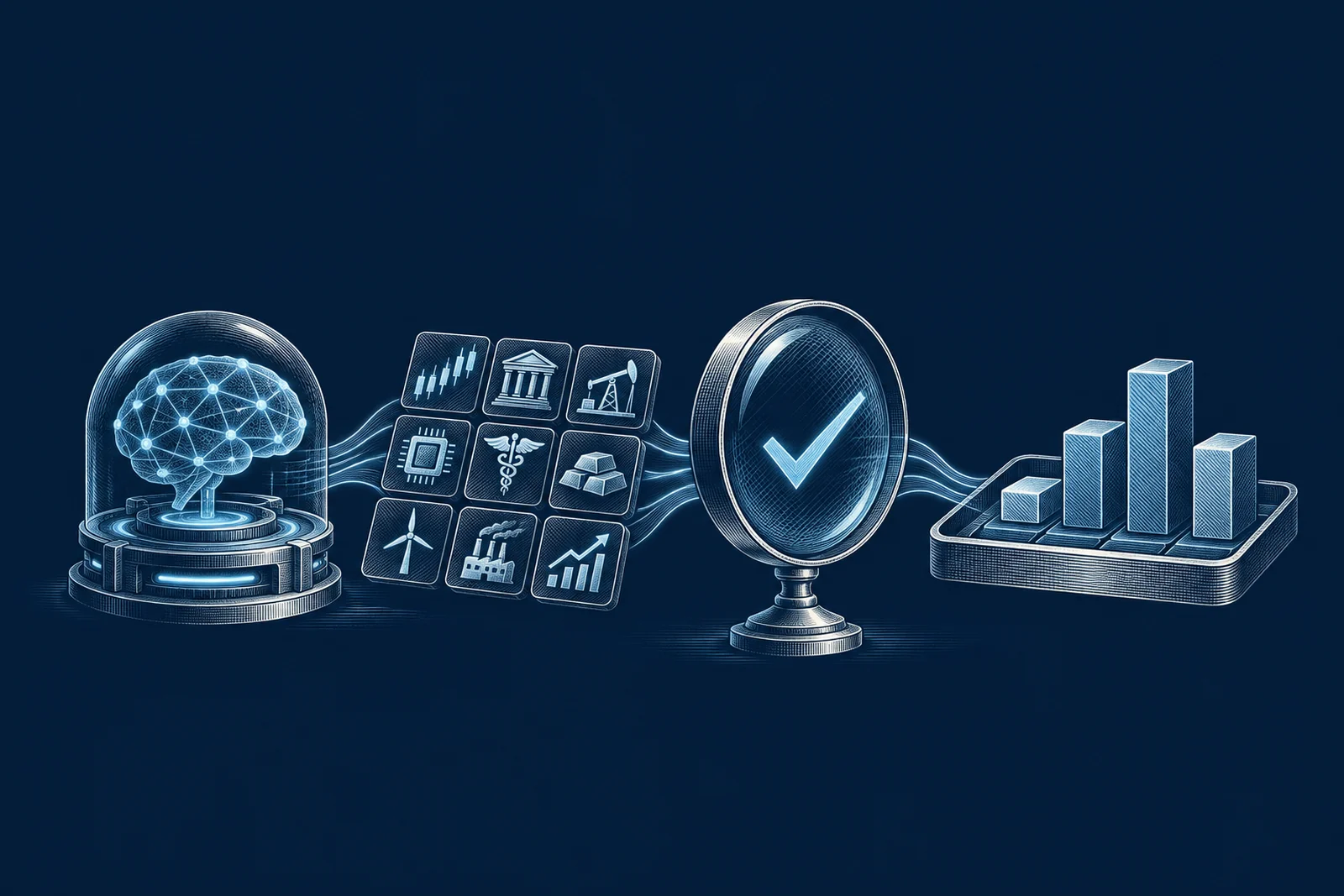
The way out of that loop is not a smarter agent on top of the same inputs. It is a customized pointer: a deliberate, curated surface of writers and analysts who are doing original work, fed into a system that can synthesize, verify, monitor, and act on it at the speed and scale that the writers themselves cannot. The agent is the easy part. Pointing it at something worth reading is the entire game.
Concretely, this is what Freeport is building. We continuously read the highest-signal writing in financial markets; independent analysts on Substack, the credible accounts on Twitter, the major financial journalists, the live newswire; and turn that surface into a filtered feed of trade-relevant ideas in something close to real time.
When a writer you’ve trusted before flags a setup, the notification finds you. When a thesis is quietly building across several independent sources, we surface that convergence before it becomes a consensus headline. And on top of the raw feed, we publish synthesis on the themes themselves: what is actually being talked about this week, which catalysts have already fired and which are still ahead, where the smart writers agree, and where the disagreement is doing real work. The pointer is curated. The processing is automated. The judgment that matters is still yours.
We believe that this is also where the durable reward is. Short-term, latency-driven arbitrage has been effectively monopolized by the firms with the fastest infrastructure; that contest is over, and it was over before most of us showed up.
The edge still available to traditional investors, hedge funds, and quant strategists is at the horizon of weeks, months, and years, where the constraint is not how fast you can act, but how well you can read the world. AI is enormously useful at that horizon, because it lowers the cost of reading the world. It does not, and for some time will not, lower the cost of seeing it differently.
That is the distinction Freeport is built on. AI does the reading. Humans, the best ones, still do the seeing. Our job is to make sure the readers are pointed at the right writers, and that what comes out the other side is something better than a rerun of everyone else’s trade.
Disclaimer
The information provided on TheLogbook (the “Substack”) is strictly for informational and educational purposes only and should not be considered as investment or financial advice. The author is not a licensed financial advisor or tax professional and is not offering any professional services through this Substack. Investing in financial markets involves substantial risk, including possible loss of principal. Past performance is not indicative of future results. The author makes no representations or warranties about the completeness, accuracy, reliability, suitability, or availability of the information provided.
This Substack may contain links to external websites not affiliated with the author, and the accuracy of information on these sites is not guaranteed. Nothing contained in this Substack constitutes a solicitation, recommendation, endorsement, or offer to buy or sell any securities or other financial instruments. Always seek the advice of a qualified financial advisor before making any investment decisions.