


Every year, trillions of dollars of structured products are sold to retail investors around the world. In this post we discuss what happens to the risk that investment banks take on when they manufacture those products, and how that risk create persistent dislocations.
What Are Structured Products
Structured products are pre-packaged investment instruments sold primarily to retail investors. For example, an autocallable note on the EuroSTOXX 50 that pays a 10% annual coupon as long as the index doesn’t fall below 70% of its starting level, and automatically “calls” (matures early) if the index is above some predefined level on an observation date. Or a capital-protected note that guarantees your principal while giving you partial upside participation in the S&P 500.
These products are sold in enormous volumes across the globe. In the US in particular, the structured notes market has seen substantial year-over-year growth, fueled by rallying equity markets and high autocall rates that keep recycling investor capital into new issuance.
However, when an investment bank sells a structured product, it takes on derivative risk. The bank’s exotics trading desk must hedge that risk. Some of those hedges are straightforward. Others leave the bank with residual exposures that are illiquid, one-directional, and difficult to offset in the open market. That residual risk is the raw material for risk recycling.
Risk Supply Chain
To understand risk recycling, you need to understand the supply chain. A retail investor in Milan buys an autocallable note linked to three European blue-chip stocks from their private bank. That private bank sources the product from a dealer - say, Goldman Sachs, JP Morgan, or BNP Paribas. The dealer’s structured products desk prices the note, embeds its margin, and issues it. At the moment of issuance, the desk is now short a complex derivative: it has sold the investor upside participation, coupon payments contingent on barrier levels, and early redemption features.
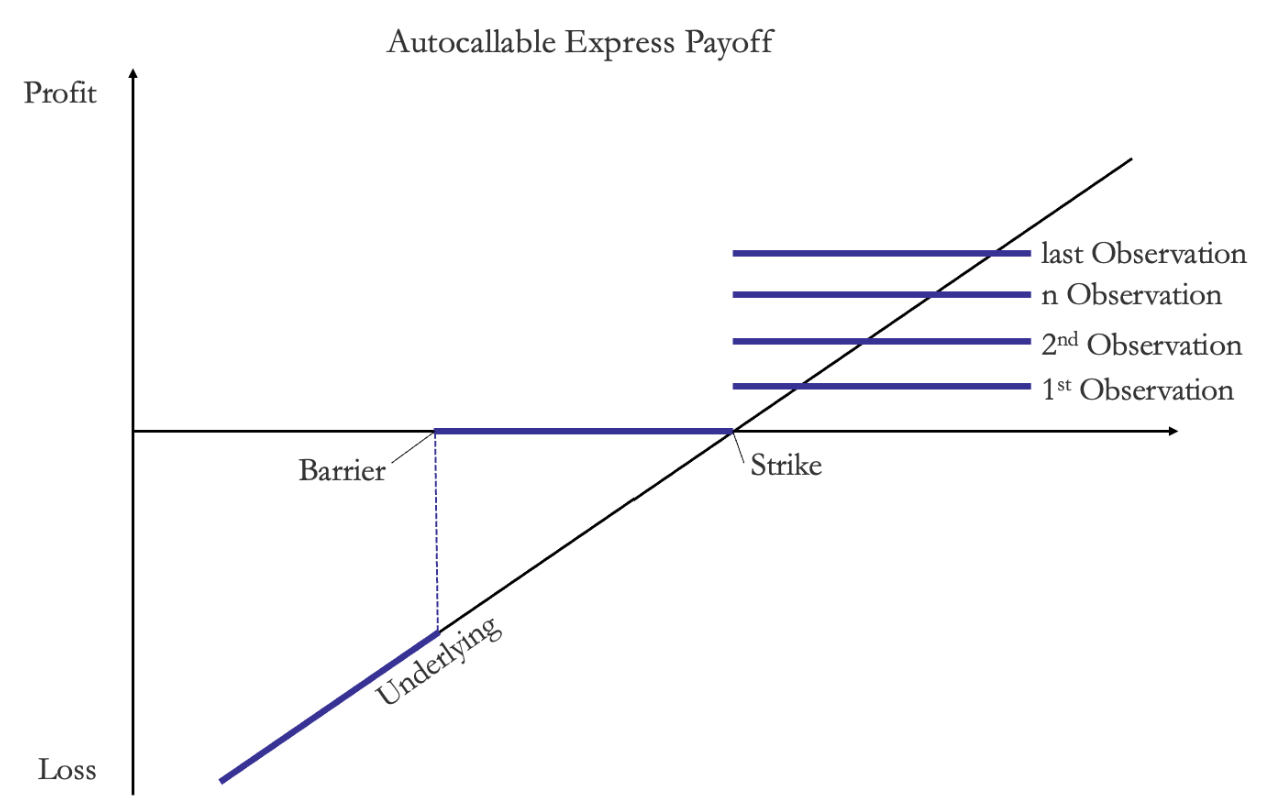
The exotics desk then hedges. It delta-hedges by trading the underlying stocks. It manages its vega (volatility exposure) by trading options and variance swaps. It hedges its dividend risk, its correlation risk, and its exposure to the shape of the volatility surface across strikes and tenors.
But here is where it gets interesting. Many of these hedges are imperfect. The desk ends up warehousing residual risks in parts of the market where there is no natural offsetting flow. When you aggregate thousands of structured product tickets, each with slightly different strikes, maturities, and underliers, you find that the desk accumulates large, persistent, one-directional exposures in specific derivative parameters. These are the dislocations.
Major Dislocations
The structured products machine creates structural imbalances in equity derivative markets. Understanding these is key to understanding why risk recycling opportunities exist and persist.
Single-stock volatility is structurally cheap. Call overwriting funds and yield-seeking investors are constant sellers of single-stock volatility. The result is that there are far more sellers than buyers of single-stock vol, and implied volatility on individual names trades at a persistent discount to subsequent realized volatility. We can look at the historical difference in realized volatility vs the implied volatility (the Volatility Risk Premium, or VRP) for both index (SPX) and single stock (Top 100 SPX) volatility.
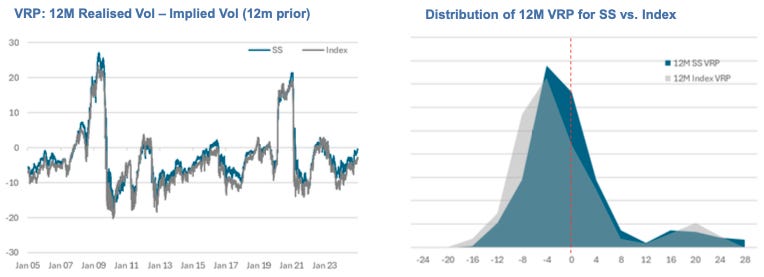
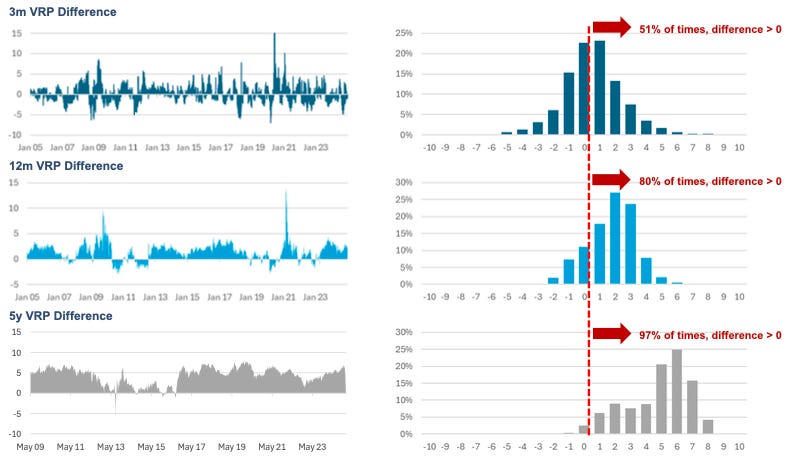
Index volatility is structurally expensive. The opposite dynamic plays out at the index level. Portfolio hedgers, variable annuity programs, and institutional accounts buying equity protection are all persistent buyers of index options. This means index implied volatility tends to trade at a premium to realized - the classic “volatility risk premium” that short-vol strategies harvest.
Implied dividends trade at a discount. Structured products are typically quoted on price-return (not total-return) underliers. This means the bank, when hedging, ends up long dividend exposure. It must sell that dividend risk into the market. But there are few natural buyers of forward dividends (think about it, who do you know that buys forward dividends?), especially on single stocks. The result is that implied dividend levels consistently undershoot where dividends actually come in. Looking at the EuroSTOXX 50, implied dividends have traded at a discount to realized in almost every year except during the Global Financial Crisis and the COVID crash.


The Business Model of Risk Recycling
Risk recycling is fundamentally a partnership between the bank’s structured products desk and its institutional clients. The bank has two motivations: it wants to manage the size of its warehoused risk positions, and it wants to free up capacity to continue issuing structured products on the primary side. The institutional investor gets access to derivative exposures priced at levels that reflect the structural imbalance rather than fair value.
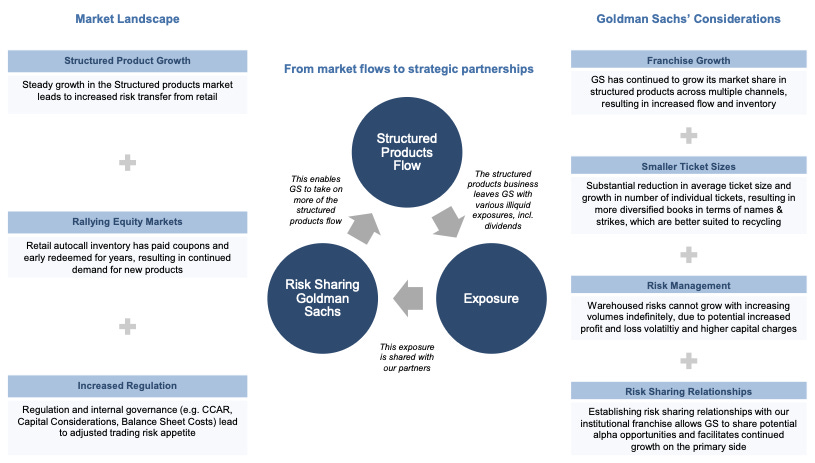
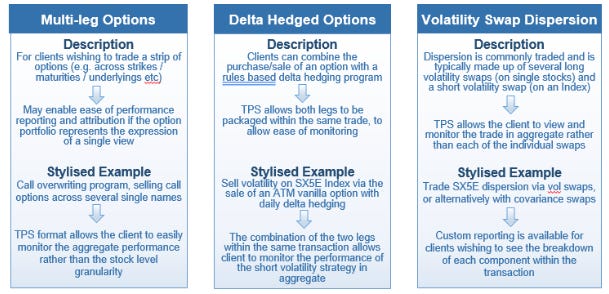
The process works as follows. The bank’s exotics desk identifies the parameters where its inventory is largest - perhaps it is long single-stock vega on a basket of European names, or short correlation between FTSE and Nikkei, or long dividends on a set of US mega-caps. The desk designs a trade that transfers some of that exposure to an institutional counterparty. The trade is structured to suit the investor’s risk appetite and operational preferences. Increasingly, banks offer a “Trade Performance Swap” wrapper that packages complex multi-leg derivative trades into a single, simplified OTC transaction with a Bloomberg ticker for easy monitoring.
The bank typically offers these trades at levels that are inside its own marks - meaning the investor gets to buy an asset at a discount to where the bank values it internally. This is rational for the bank because reducing inventory lowers capital charges, reduces P&L volatility, and enables continued growth in the primary business of issuance.
Summary
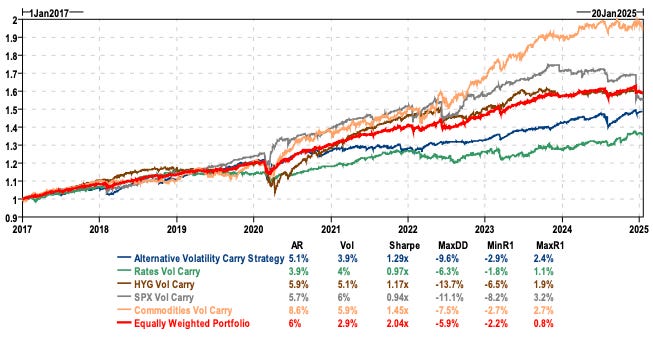
Risk recycling sits at the intersection of retail distribution, bank risk management, and institutional alpha generation. The structured products business creates large, predictable, one-directional flows in equity derivative markets. Those flows distort prices in specific parameters - single-stock volatility, dividends, correlation, and volatility on custom indices. Investment banks, constrained by capital rules and risk limits, are willing to share those exposures with institutional partners at structurally attractive levels. The result is a set of opportunities that offer genuine diversification, carry, and convexity.
Disclaimer
The information provided on TheLogbook (the "Substack") is strictly for informational and educational purposes only and should not be considered as investment or financial advice. The author is not a licensed financial advisor or tax professional and is not offering any professional services through this Substack. Investing in financial markets involves substantial risk, including possible loss of principal. Past performance is not indicative of future results. The author makes no representations or warranties about the completeness, accuracy, reliability, suitability, or availability of the information provided.
This Substack may contain links to external websites not affiliated with the author, and the accuracy of information on these sites is not guaranteed. Nothing contained in this Substack constitutes a solicitation, recommendation, endorsement, or offer to buy or sell any securities or other financial instruments. Always seek the advice of a qualified financial advisor before making any investment decisions.