



Large traders usually hide their intentions because revealing an order’s size and direction appears to invite front-running. Yet price impact reflects two different forces: information about an asset’s value and the temporary pressure created by a need to trade. When market makers cannot distinguish an informed trader from a benign trader, they must price every hidden order as a mixture of both. Hiding therefore protects genuine alpha, but it also forces uninformed traders to pay an adverse-selection premium.
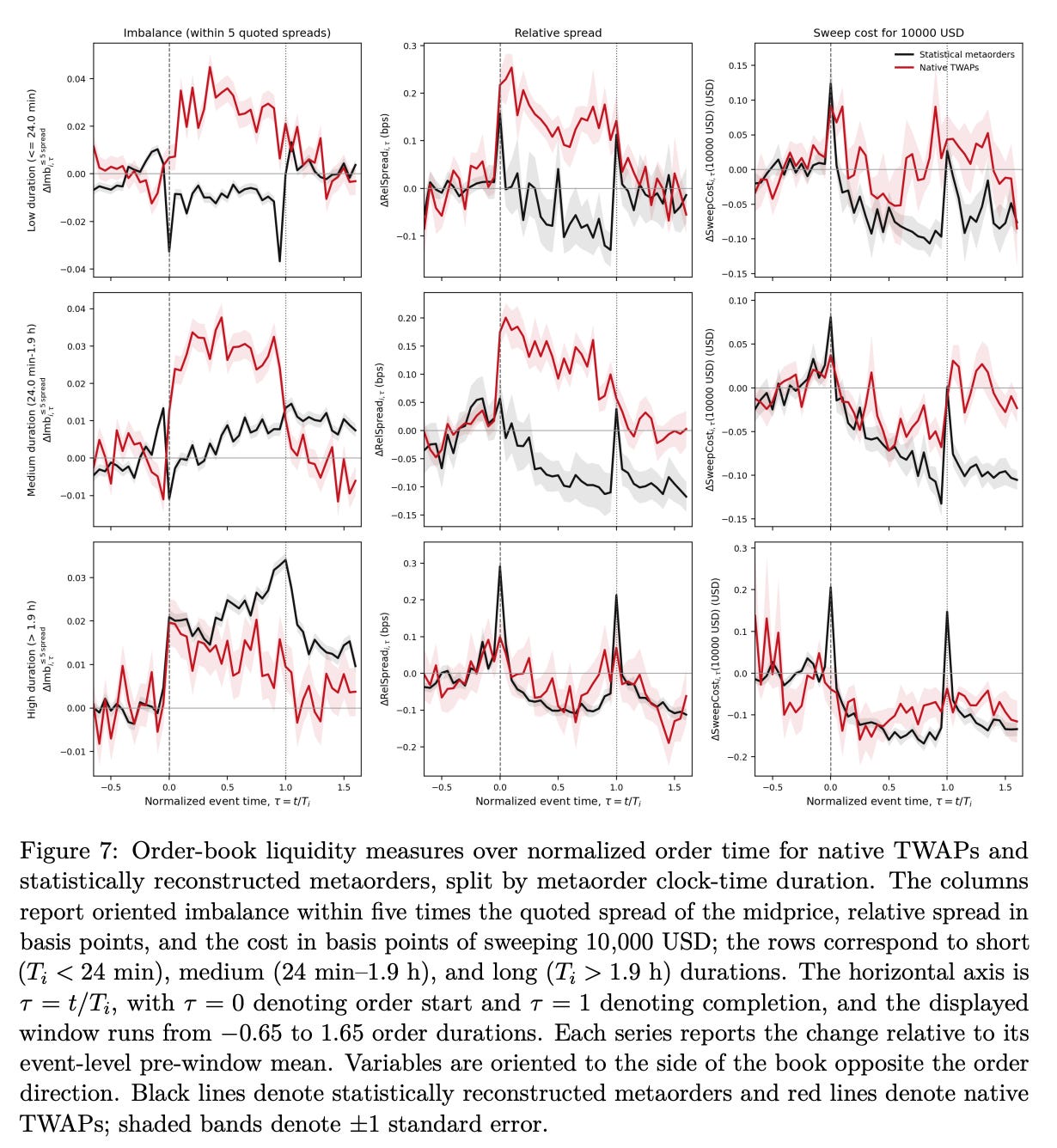
Hyperliquid offers a rare test of the alternative. Its protocol-native TWAP orders publicly reveal their direction, total size and duration while they execute. Comparing 465,000 visible TWAPs with 4.3 million reconstructed hidden metaorders, Barone and Lillo (in Trading in the Sunshine or in the Shade: Market Impact and Adverse Selection on Hyperliqui) find that visible orders face lower execution costs, leave less permanent price impact and attract additional liquidity. Displayed depth increases while these orders run, and the order book tilts toward the side needed to absorb them, especially for larger programs.
The conclusion is not simply that transparency is always better. Transparency sorts order flow. Traders willing to make their demand predictable allow market makers to compete for relatively benign flow, while hidden orders become more likely to contain private information and bear more of the adverse-selection cost. Secrecy remains valuable when protecting real alpha, but for traders executing for mechanical or liquidity reasons, trading “in the sunshine” can produce better execution.
Market Making & Adverse Selection
Trades do not arrive labeled “benign inventory demand” and “toxic private information.” A resting limit order is an offer to trade against whoever arrives next, including someone who may or may not know more. Liquidity providers protect themselves by widening the spread, showing less size, or moving their quotes after suspicious flow. The uninformed trader ends up paying part of the cost created by informed traders because both are drawn from the same pool.
Put differently, adverse selection is partly a classification problem. The market maker is not only estimating how many dollars a buyer wants to trade. It is estimating what those dollars mean. Flow is toxic to a liquidity provider when trading against it predicts an adverse markout, whether the advantage comes from information, latency, or some other structural edge.
In 1991, Anat Admati and Paul Pfleiderer formalized a way for liquidity traders to separate themselves in Sunshine Trading and Financial Market Equilibrium. If part of future liquidity demand is announced, market makers no longer need to assign the same information premium to it. The remaining unannounced flow also becomes more informative because known liquidity demand has been removed. Counterintuitively, revealing some uninformed trading can improve both the announcer’s execution and the information content of prices.
Preannouncement can also change who supplies liquidity. A known buyer gives market makers time to arrange capital, hedge on another venue, and decide how much inventory they are willing to warehouse. In Admati and Pfleiderer’s costly-entry model, the benefit is strongest when the announced demand draws in suppliers who would otherwise stay out.
Of course, the announced order can also be front-run. In a model of stealth versus sunshine trading, Torsten Schöneborn and Alexander Schied show that disclosure can attract counterparties or predators depending on market liquidity, the number of competitors, and their trading horizons. The question is not whether someone can trade ahead of a known order. They can. The question is whether the extra cost from anticipation is larger or smaller than the benefit from classification and competing liquidity supply.
Predictable Trading Literature
Traditional markets make the question difficult to test. But there are two close precedents. Nasdaq once allowed “flash orders,” briefly showing an order to a subset of participants before routing it elsewhere. Skjeltorp, Sojli, and Tham find that Nasdaq liquidity and overall market quality improved after the functionality appeared and deteriorated when it was removed. Their interpretation is that less-informed traders advertised liquidity needs and liquidity providers responded.
The scheduled roll of the United States Oil Fund (and other similar predictable institutional flow) provides another example. The fund had to move a large crude-oil futures position each month on a predictable schedule. This sounds like ideal prey. Instead, Bessembinder, Carrion, Tuttle, and Venkataraman find narrower spreads, greater depth, better resiliency, and more accounts supplying liquidity on roll dates, without evidence of systematic predatory trading. When impact is partly temporary and the market is resilient, absorbing the order can be more profitable than racing ahead of it. Competition then improves the liquidator’s proceeds.
Neither setting is the same as Hyperliquid. Nasdaq’s disclosure was selective and lasted only briefly. The USO roll was inferred from a calendar rather than announced through a protocol. They nonetheless show why a predictable order need not be a defenseless one: predictable demand can recruit its own liquidity.
Hyperliquid TWAP
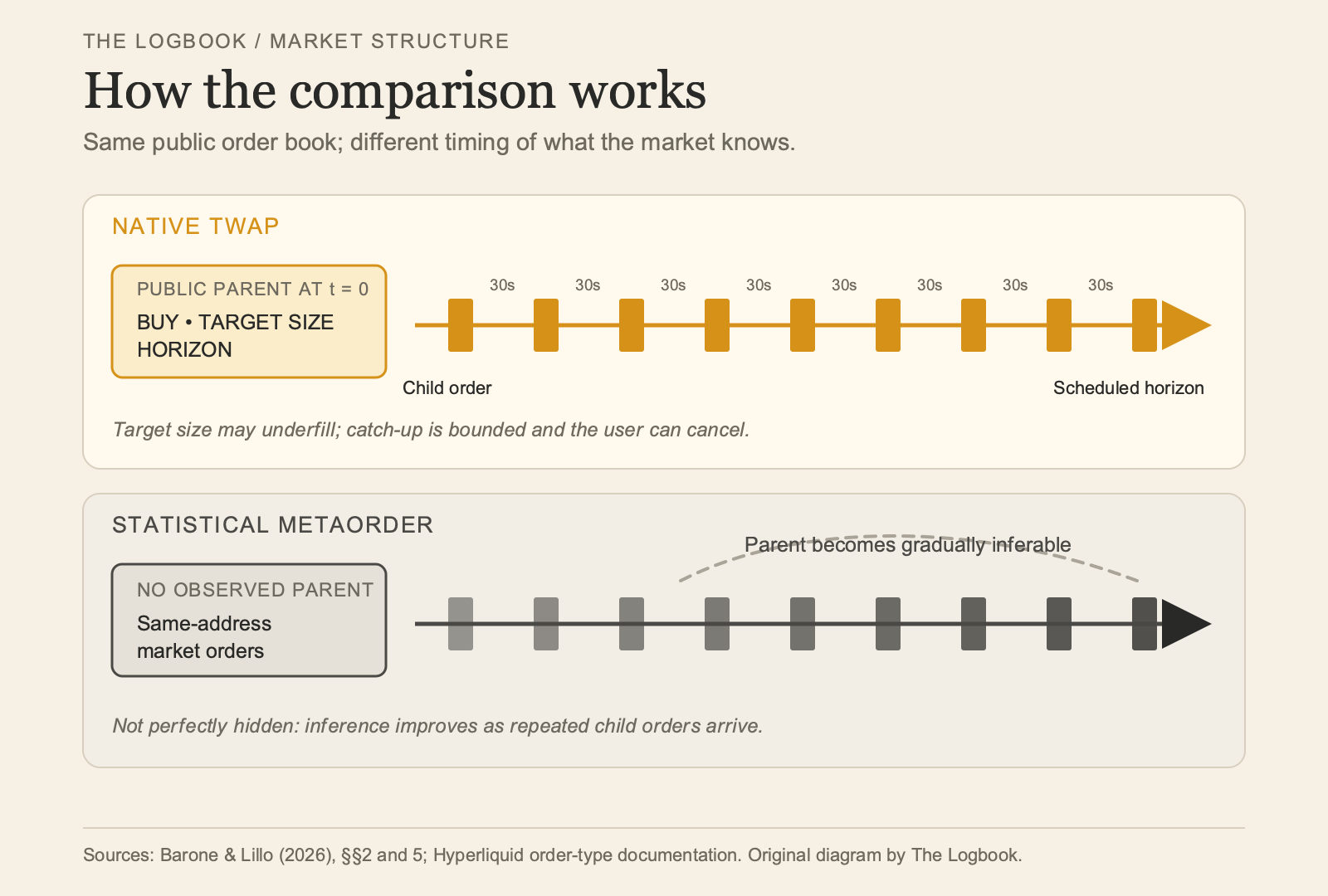
Hyperliquid runs the largest centralized limit order book onchain. During the sample studied in the paper, its native TWAP mechanism submitted an order every thirty seconds and targeted a constant execution rate through time. Each slice was subject to a 3% maximum-slippage constraint, and underfilled slices could be made up later at no more than three times the normal child-order size.
The important feature is that the parent order is visible while it is active. Once the TWAP begins, the market can observe its direction, total size, and horizon. This is more informative than simply watching a series of buys appear on the tape. The remaining scheduled demand is known rather than guessed.
Anyone can announce an intention to buy. A native TWAP immediately begins carrying out the schedule under protocol rules. It can underfill if later slices fail to catch up, and the user can cancel it, so the displayed size is not a guarantee of completed volume. While the program is active, however, its parameters and progress are publicly verifiable on the Hyperliquid blockchain.
Barone and Lillo compare these visible programs with what they call statistical metaorders: sequences of same-address, same-market, same-direction market orders separated by less than thirty minutes. The statistical parent order is not directly observed. It is reconstructed from the child orders after the fact and becomes only gradually inferable while it is running.
Execution Schedule Features
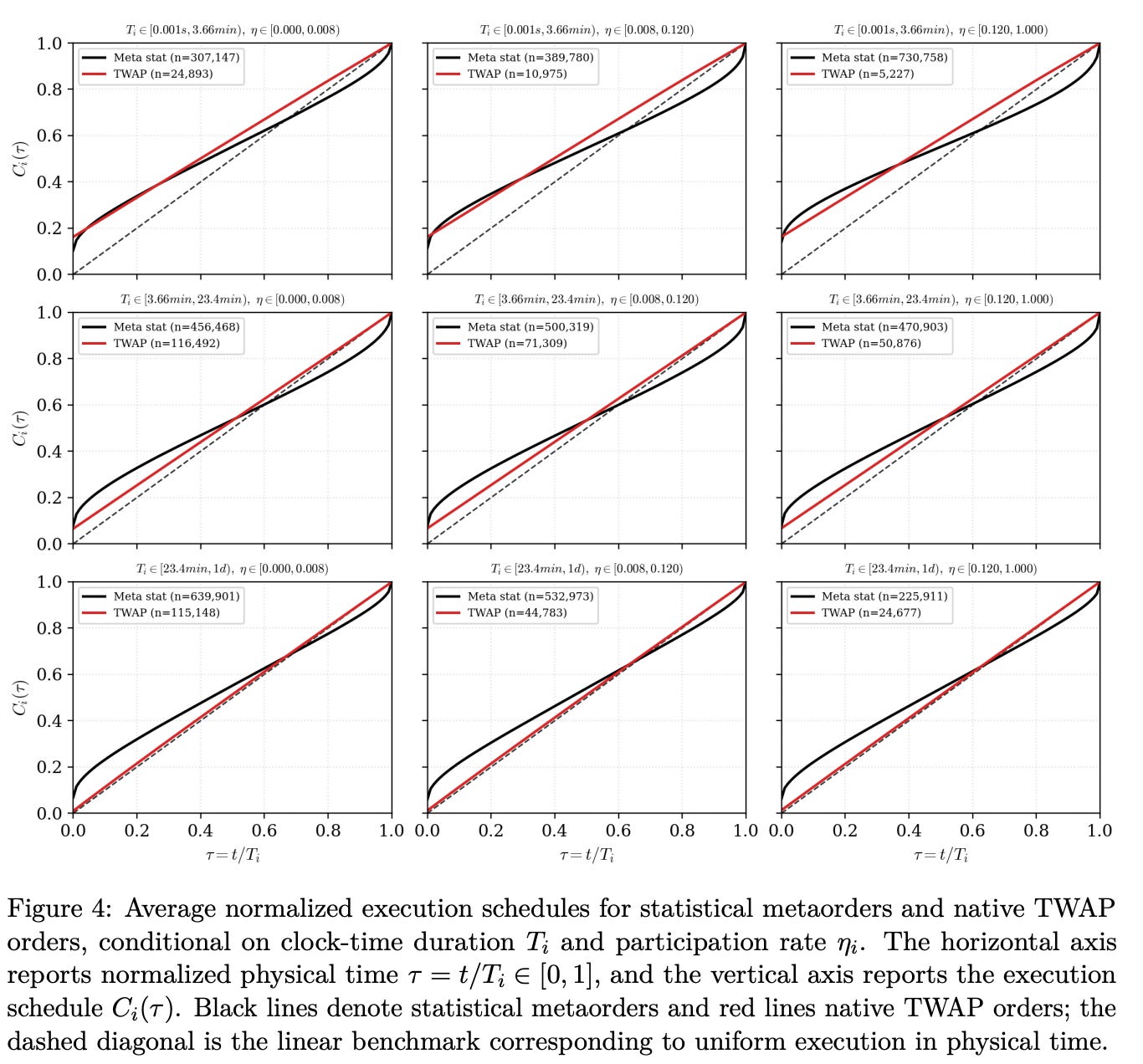
Native TWAPs execute nearly linearly through time, as the mechanism intends. Their average price path is smooth and concave: impact rises quickly at first and then more slowly, reasonably close to the square-root trajectory produced by uniform trading under a transient-impact model.
Statistical metaorders are U-shaped. During the first tenth of their execution window, they trade at roughly 1.5 to 1.7 times the uniform rate. They slow to 0.6 to 0.8 times uniform in the middle, then accelerate to around 1.1 to 1.4 times uniform near completion. Their price trajectories inherit the same shape: impact bends twice, peaks sharply around completion, and decays afterward.
Price Impact Features
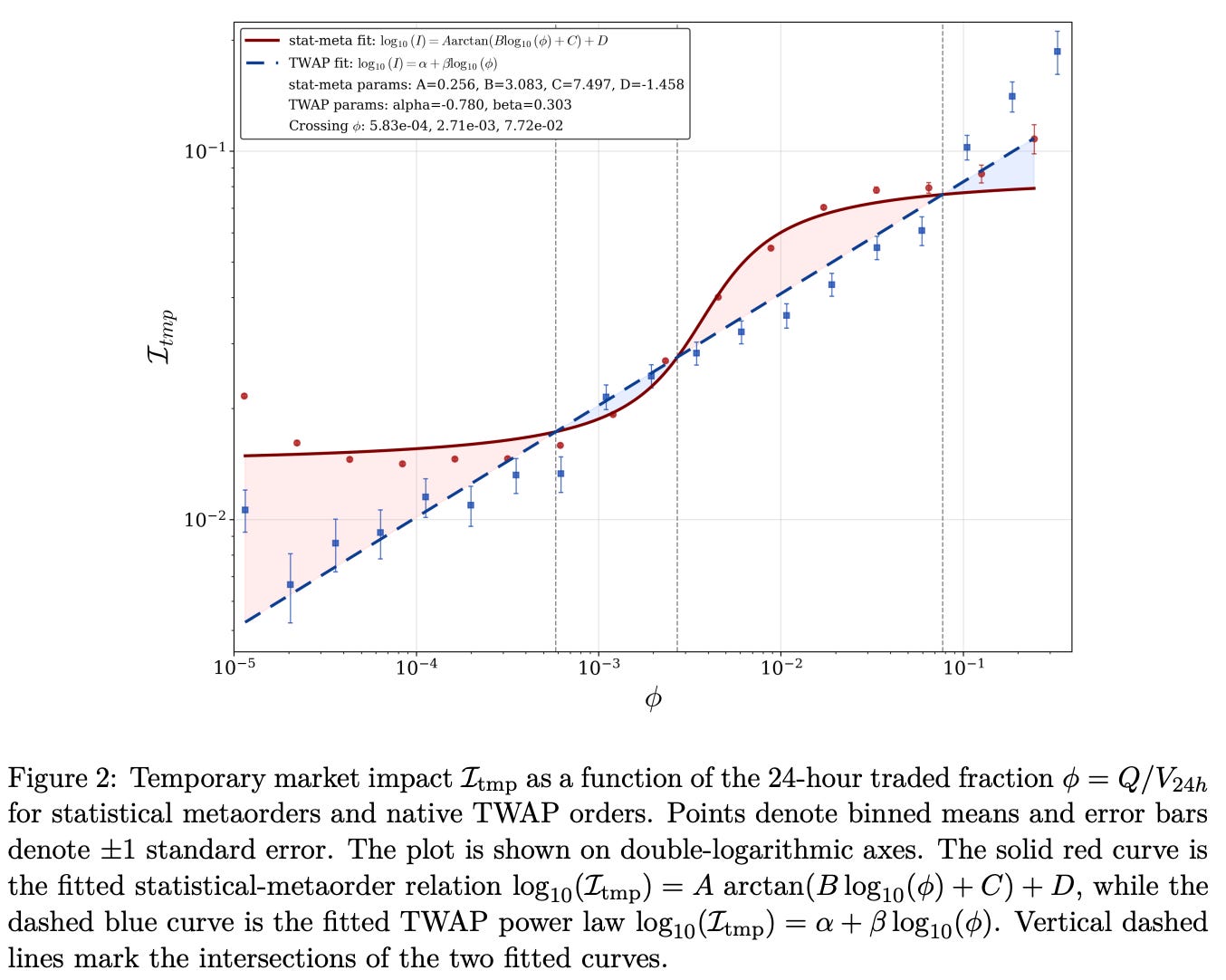
The two populations are not described by a common aggregate impact curve. Native TWAP orders display an approximately linear relation in log-log scale over the displayed range. Statistical metaorders display a markedly different shape. Their binned impact is fitted by the nonlinear arctangent specification.
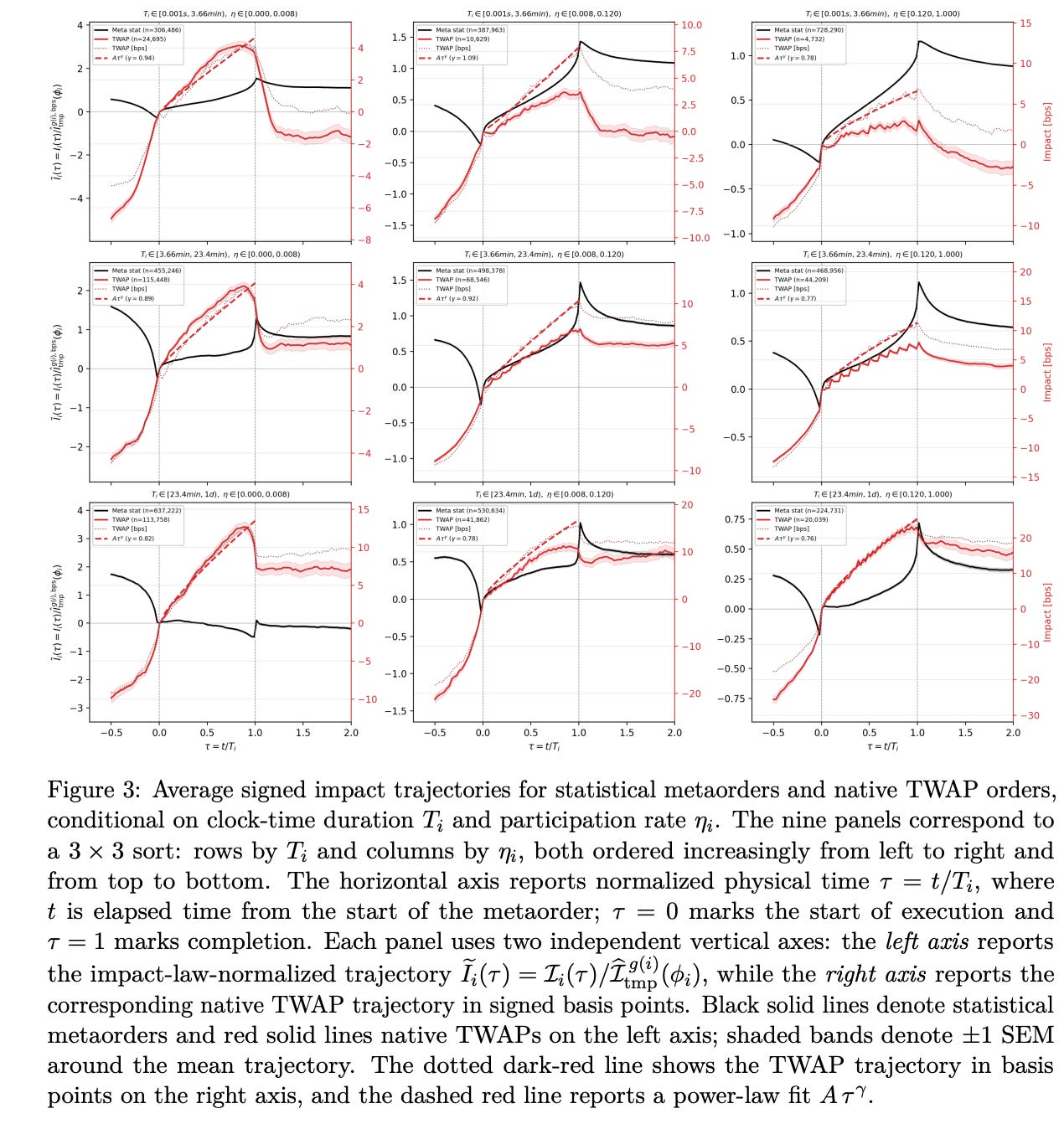
Plotted in signed basis points on the right vertical axis, the TWAP trajectories display the typical concave, square-root-like profile documented in the empirical literature, rising as execution proceeds and well fitted by a power law.
Statistical metaorders display a different dynamic pattern. Their trajectories are markedly non-concave, with a double-inflection shape, a sharp peak around completion, and a more pronounced post-trade decay. This suggests that the difference between statistical metaorders and native TWAPs is not only a difference in impact levels, but also in the way impact accumulates during execution and relaxes afterwards. Such patterns are consistent with optimal execution under transient-impact models, which prescribes a U-shape in the trading velocity.
Announcer Execution Discount
If preannouncement separates visible liquidity demand from potentially informed order flow, or if it attracts additional liquidity supply when entry margins are important, announced orders should face lower execution costs than comparable latent orders. We test this prediction by comparing the volatility-normalized temporary impact of protocol-native TWAPs and statistical metaorders.
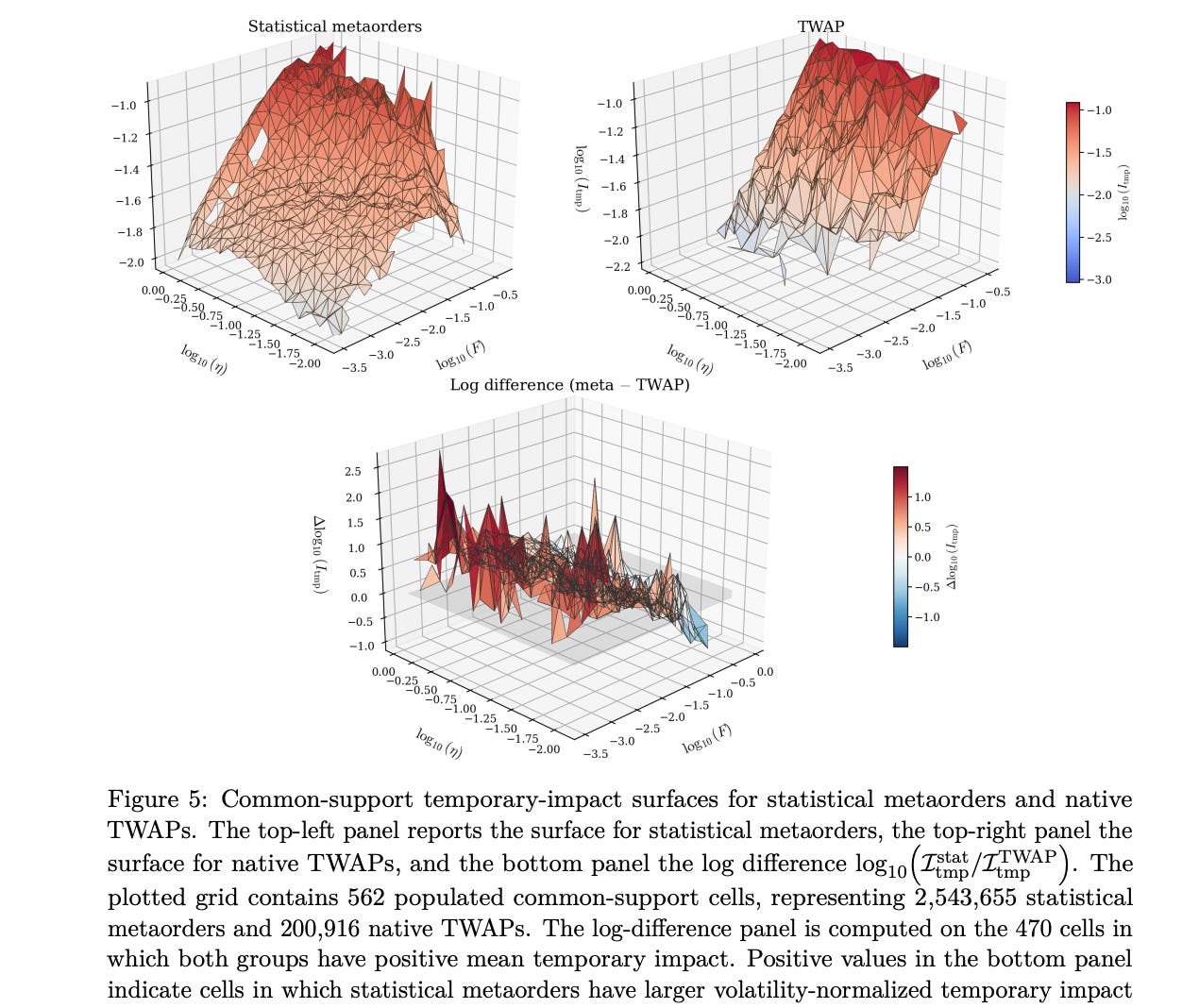
On common regions of participation and volume-time duration, statistical metaorders have greater temporary impact than native TWAPs in 81% of populated cells. Weighting each cell by the smaller sample increases the figure to 88%.
Among cells where both group means are positive, the median ratio of statistical to TWAP impact is about 2.3. The difference is concentrated among shorter and intermediate executions. The median statistical-to-TWAP impact ratio is about 5.4 for the shortest volume-time group and 3.1 for the intermediate group.
Among the longest executions, the surfaces nearly converge and the sign becomes unstable. The visible-versus-latent gap is not equally large everywhere. At the median execution profile and median daily volatility, a native TWAP has about 8.9 basis points less temporary impact than a comparable statistical metaorder.
Announcer Permanent Impact
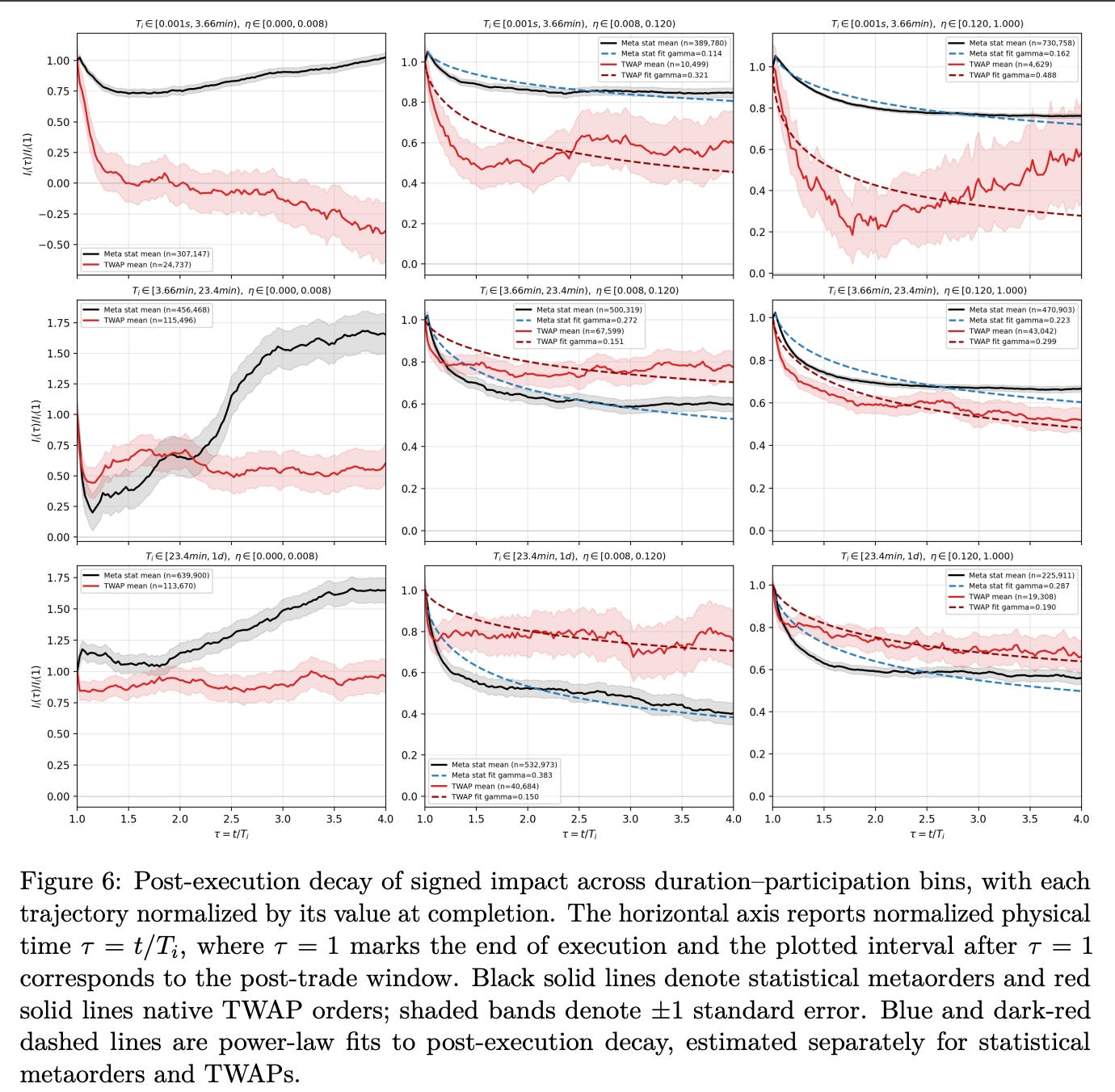
The paper also studies the price after execution. Mechanical impact should decay as market makers redistribute inventory. Informational impact should persist because the trade has changed the market’s estimate of fair value. The amount of signed displacement left after completion is a useful proxy.
The authors measure prices half, one, two, and three execution durations after completion, not at an infinite horizon. At those four points, native TWAPs are associated with roughly 5.0 to 5.5 basis points less signed price displacement than statistical metaorders after controlling for relative size, participation, duration, volatility, market, hour, and day.
Impact on Unannounced Flow
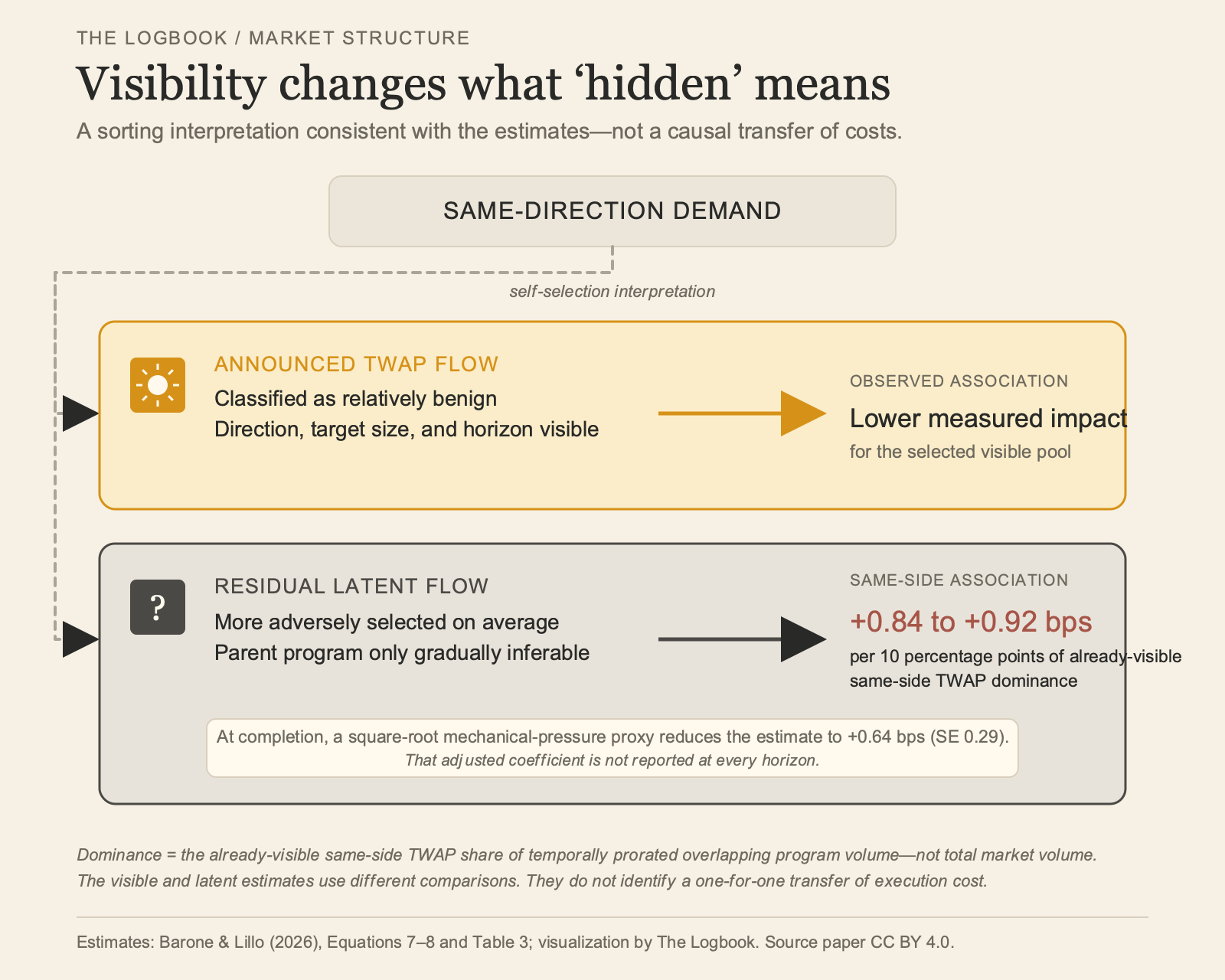
We now focus on hidden traders who execute while visible TWAP flow is active. The key question is whether the presence of announced order flow changes the cost of latent metaorders. If visible TWAPs are interpreted by the market as relatively uninformed liquidity demand, then hidden same-side trading may become a more adversely selected residual category and therefore face higher execution costs. At the same time, visible TWAP activity may also attract liquidity supply, in which case hidden traders could benefit rather than suffer.
The data shows that a ten-percentage-point increase in already-visible same-side TWAP dominance is associated with roughly 0.84 to 0.92 basis points more signed impact for the statistical metaorder, from completion through three order durations afterward. Two simultaneous buyers will mechanically push in the same direction, so part of the relationship could simply be shared price pressure.
The authors add a square-root-law proxy for the mechanical pressure of overlapping flow. At completion, the already-visible same-side coefficient falls from about 0.86 to 0.64 basis points per ten percentage points of dominance, but remains positive. The adjusted coefficient is reported for this horizon only.
Impact on Liquidity
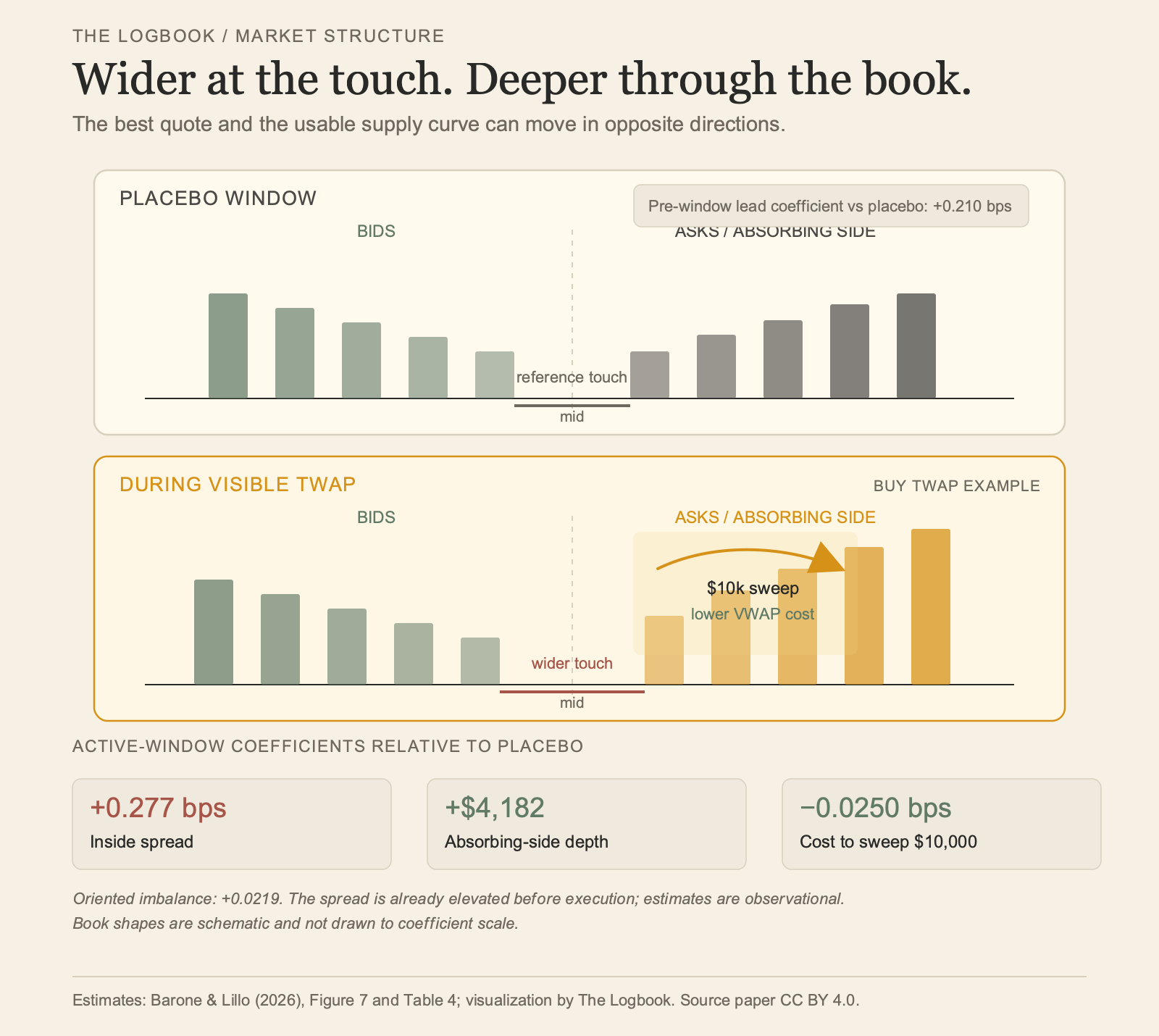
During active TWAP windows, the quoted spread is around 0.28 basis points wider. If liquidity is defined only as the best bid-ask spread, it does not degrades. However, displayed depth on the absorbing side, measured within five quoted spreads of the midprice, increases by about $4,200. The book tilts in the same direction: asks accumulate during a buy and bids during a sell. The cost of immediately sweeping $10,000 falls by approximately 0.025 basis points.
One interpretation is that an announced buyer creates predictable inventory risk: market makers need not place all additional size at the best ask, but can add it behind the touch at prices that compensate them for holding inventory.
Transparency, Competition, and Market Efficiency
Competition does not mean that nobody can trade ahead of a public order, but it does mean that a repeatable opportunity attracts capital. A market maker who sees a future buyer can acquire or hedge inventory before later slices arrive, then quote more size. If the price offered is too high, another maker can undercut it.
Anticipation may move part of the price response earlier, but competition determines how much of the opportunity remains as rent and how much comes back to the trader as better execution.
The paper observes only the net outcome: visible orders have lower measured impact in the conditional comparisons, and active TWAP windows have more displayed depth. It cannot separately quantify predation or tell us how the same orders would have performed if hidden.
This only works if competition is real. If access is controlled by a small set of firms, predictable flow can become a toll road. Public information helps the trader when multiple counterparties can act on it and compete away part of the rent. Hyperliquid has shown that it has sufficient competition on its platform such that announcing larger order is indeed optimal for execution in expectancy.
System-level transparency on blockchains makes the same information available to firms competing to fill the order. This stands in contracts to traditional centralized markets where a broker, venue operator, dark-pool participant, or fast observer often sees information first. That can be the worst equilibrium: enough information to create a rent, but not enough access to compete it away.
We discussed the broader version of this issue in Market Fragmentation. Competition among venues is not the same as competition for an order. Dark pools, internalizers, and OTC dealers can give particular customers excellent execution while removing uninformed flow from the central book that supplies the reference price. The customer-level result may be good even as the public market inherits a more informed residual pool.
Hyperliquid presents a different arrangement. The order book and execution signal are shared. The native TWAP functions like a public request for liquidity rather than a request sent to one dealer. Any market maker with the required infrastructure can compete for the flow, and the address history is not locked inside one broker’s database. In principle, repeated fills let market makers estimate whether an account’s trades predict later prices and whether its flow is usually mechanical or opportunistic.
Traditional dealers build the same histories privately. An onchain market can make the economically relevant part of that repeated game public without tying the address to a legal identity, although the paper does not test whether makers use those histories this way.
CLOB vs AMM Announced Execution
At first the results in the paper seems inconsistent with our post on order routing, where we argued for keeping large swaps out of public mempools and using private relays or resolver auctions. It is not. A visible future schedule and a signed transaction waiting to be ordered are different objects.
A native TWAP announces a bounded schedule of future trading in an open order book. Many market makers can respond by posting liquidity, and the trader retains protections on how each child order executes.
A signed swap broadcast into a public mempool has already been authorized by the user. A block builder or searcher with control over transaction sequence can insert trades immediately before and after it. In Flash Boys 2.0, Philip Daian and his coauthors document bots competing for exactly this kind of transaction priority on early decentralized exchanges.
In the first design, visibility expands the set of potential counterparties. In the second, it can give an ordering actor a nearly free option on a trade the user has already authorized. Competition among sandwich bots may dissipate their profits into gas or builder payments without returning the value to the user whose execution deteriorated. Competition only helps the trader if the market structure points it toward the trader’s price.
Private does not necessarily mean uncompetitive. A resolver auction can conceal intent from the public mempool while making several solvers compete over a guaranteed outcome. The bad structure is selective information combined with weak competition or discretionary ordering, whether the venue calls itself public or private.
Conclusion
The lesson is not that traders should always reveal their hand. Secrecy remains valuable when an order contains genuine information or when the market structure allows others to exploit it without meaningful competition. But hiding is not free: when market makers cannot distinguish informed flow from mechanical demand, even uninformed traders pay an adverse-selection premium.
Hyperliquid shows what can happen when trading intentions are public and liquidity providers compete on equal terms. A visible order can become an open invitation to supply liquidity rather than merely an opportunity to front-run. The practical rule is simple: hide genuine alpha, but when the need to trade is mechanical, letting the market compete for the order may produce better execution.
Disclaimer: The information provided on TheLogbook (the “Substack”) is strictly for informational and educational purposes only and should not be considered as investment or financial advice. The author is not a licensed financial advisor or tax professional and is not offering any professional services through this Substack. Investing in financial markets involves substantial risk, including possible loss of principal. Past performance is not indicative of future results. The author makes no representations or warranties about the completeness, accuracy, reliability, suitability, or availability of the information provided._
This Substack may contain links to external websites not affiliated with the author, and the accuracy of information on these sites is not guaranteed. Nothing contained in this Substack constitutes a solicitation, recommendation, endorsement, or offer to buy or sell any securities or other financial instruments. Always seek the advice of a qualified financial advisor before making any investment decisions.