


Residential real estate, evaluated as a standalone asset, tends to deliver modest long-run real returns; the economic value of housing therefore comes disproportionately from the financing structure via tax-advantaged long-duration leverage.
A longer mortgage lowers required monthly payments and frees cash flow that can be allocated to higher-return assets. This logic is most relevant early in the life cycle for young professionals with high incomes or households with parental support because longer-duration borrowing improves consumption smoothing and expands investable capacity.
Real Estate is a Terrible Investment
Any serious discussion of housing returns has to begin by clearing up a visual lie we have all absorbed. The most common housing price charts are last-transaction charts which only update when a home sells.
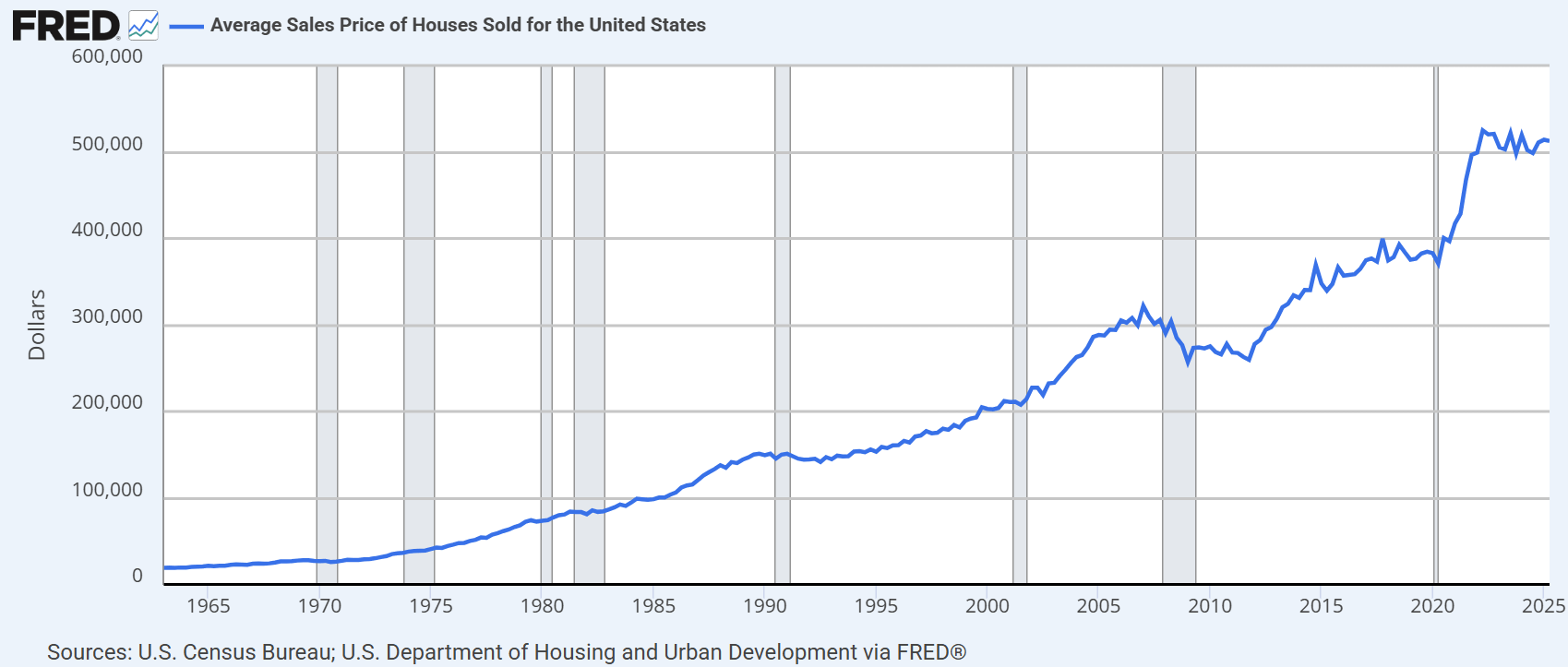
When prices are rising, transactions are frequent and the series looks smooth. When prices are falling, many owners simply don’t sell—they hold on, default, or get foreclosed—so the “price” series updates less often and can appear artificially stable. This creates the illusion that housing is smoother on the way down than it really is. Econometric indices like Case-Shiller built from rigorous statistical inference often look uglier and more volatile than the charts people circulate.
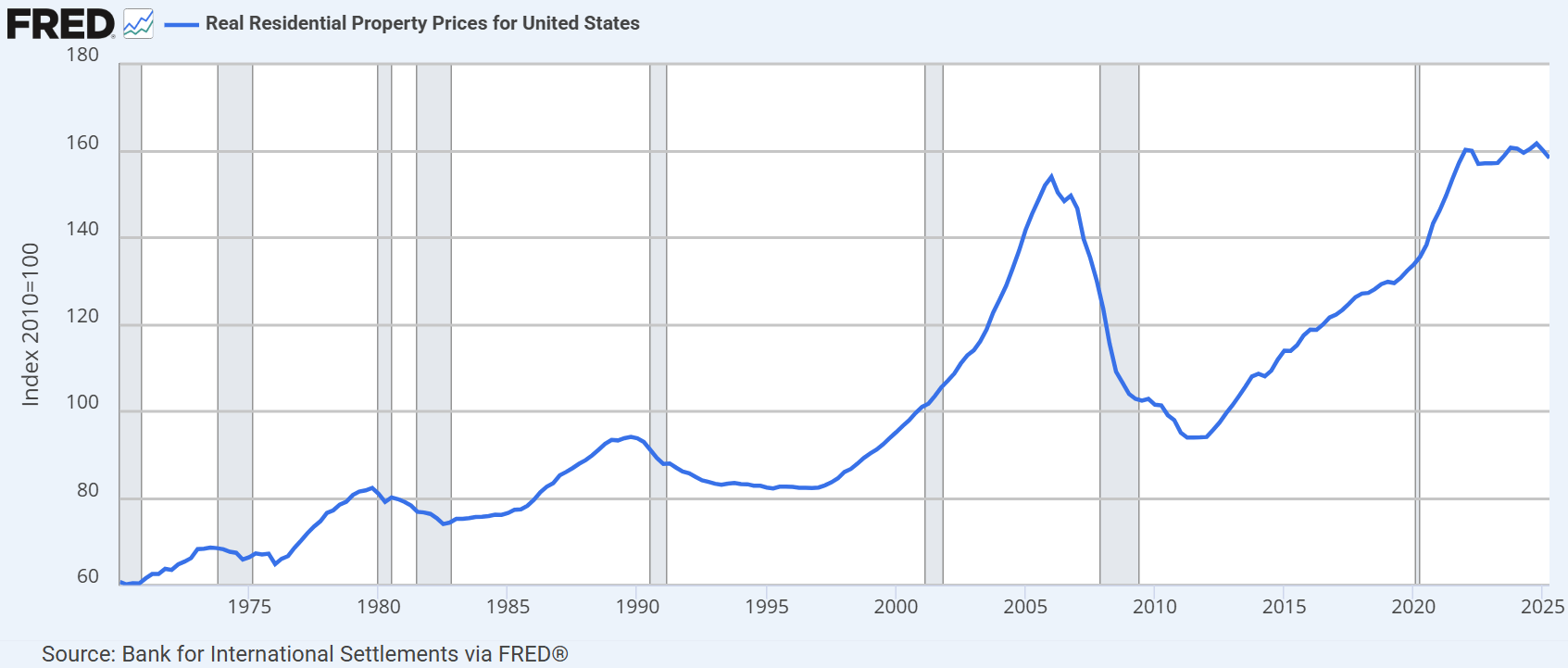
Housing does not “only go up”; it often just updates asymmetrically. Relative to stocks—especially diversified equity indices—housing tends to have lower long-run real returns and far higher idiosyncratic risk.
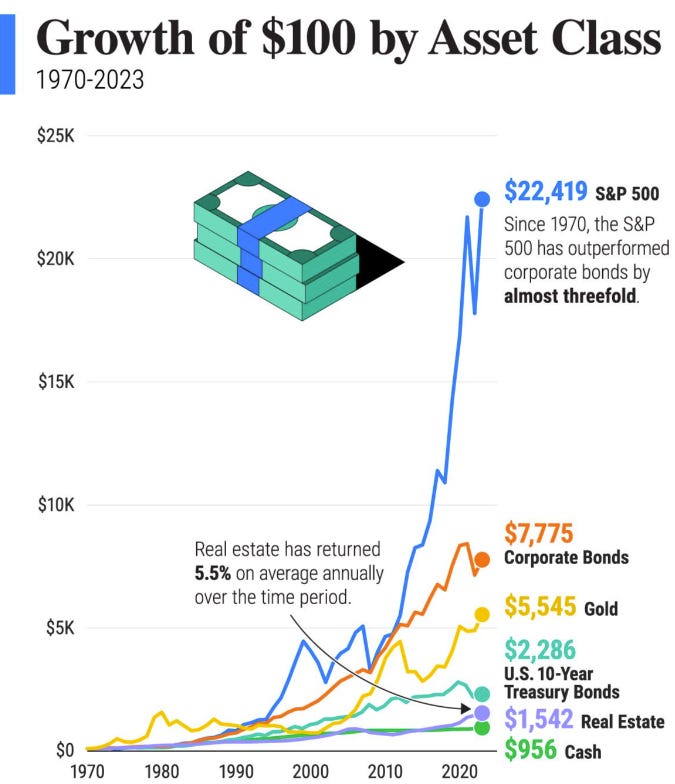
On top of that, housing has a thick layer of hidden costs: maintenance, capital repairs, insurance, property tax, transaction costs, financing frictions, and the time/stress tax of managing a highly specific physical asset.
Yes, housing is often low-beta and can be weakly correlated with public markets, but “uncorrelated with market beta” is not the same as “low risk.” What you get instead is concentrated personal risk: a zoning change, a school-district shift, a NIMBY-driven supply shock, a neighborhood-specific decline, an insurance repricing, a climate event, or a tax reassessment.
Case Study: SF Housing
San Francisco housing is widely treated as the canonical overpriced market, driven by extreme supply constraints and the political economy of NIMBY regulation. Yet even there, when you compare long-horizon housing returns to a tech-heavy equity benchmark, the housing story looks much weaker than the mythology. The striking part is that SF housing has underperformed badly when compared to an index of some of the most valuable public companies in the world over the past decade.
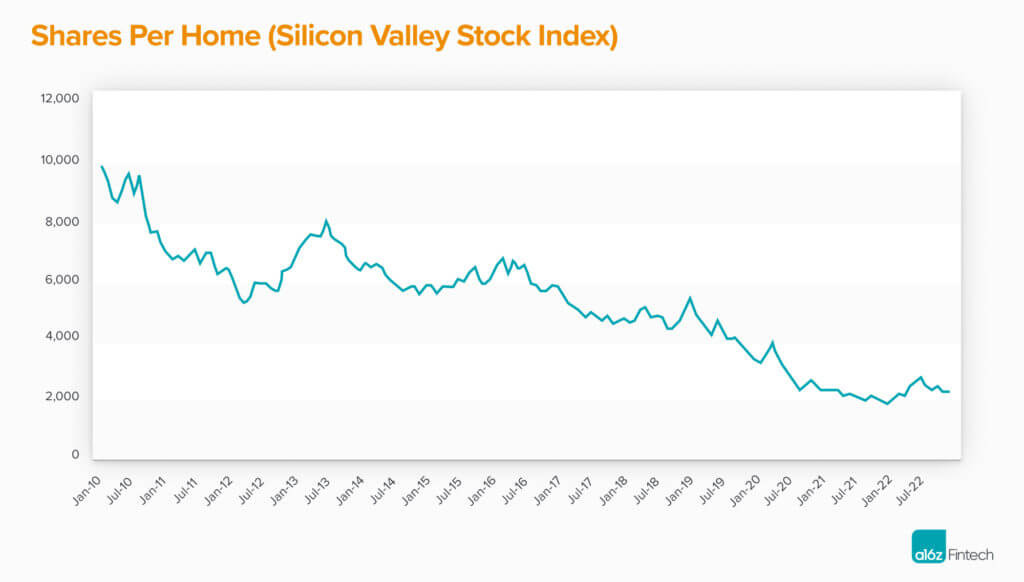
Over the last decade, the median home price in Palo Alto increased from roughly $1.3 million to $3.6 million, a change often cited as evidence of extreme housing inflation. Measured in nominal dollars, that conclusion is correct.
Measured relative to a different numeraire, however—specifically, an index of technology equities—the conclusion reverses. When housing prices are expressed in units of tech stocks rather than dollars, Bay Area housing has, in many cases, become cheaper. This is not paradoxical. It reflects the fact that the relevant question is not whether prices rise in absolute terms, but relative to what.
This relative-pricing effect is particularly salient in San Francisco, where housing is often analyzed in isolation from the asset that most directly drives local purchasing power: technology equities. High-income buyers are not purchasing homes out of stagnant wage flows; they are purchasing them with claims on capital that has appreciated rapidly. From that perspective, housing inflation is partly a reflection of asset inflation elsewhere in the system.
This is why leverage can be rational—especially for young households. Early in the life cycle, when expected income growth is high and exposure to appreciating capital is low, borrowing to acquire assets can shift households out of a purely nominal position and into one that participates in aggregate growth. In high-productivity regions like San Francisco, where local purchasing power is tied to equity markets, failing to leverage is often equivalent to implicitly shorting the dominant asset class. Properly constrained leverage is therefore not speculation but rather intertemporal balance-sheet alignment.
Mortgages Provide Negatively Priced Funding
Housing is one of the few assets ordinary households can routinely buy at 10–20x leverage with long maturities at low rates. That is extraordinary financial engineering from the household’s point of view and one of the only ways for ordinary households to borrow so cheaply.
The unusually low cost of mortgage financing is not a market accident but rather the direct result of explicit government intervention in housing credit markets. In the United States, a large share of residential mortgages are bundled into mortgage-backed securities (MBS) that carry either explicit or implicit government guarantees through entities such as Fannie Mae and Freddie Mac. These guarantees transfer credit risk from private investors to the public balance sheet, allowing mortgage debt to be priced at yields well below what would prevail in an unbacked market.
In addition, the mortgage interest deduction (currently limited to interest on up to $750k of debt for joint filing) is able to be applied to individual income (while brokerage margin rates are deductible only against capital gains).
From a financing perspective, residential mortgages can function as negatively priced funding in real terms once tax effects are taken into account. The relevant comparison is not the nominal mortgage rate, but the after-tax cost of debt relative to the expected return on alternative uses of capital.
For households able to fully utilize the mortgage interest deduction, the effective borrowing cost is reduced by the marginal tax rate applied to deductible interest. A mortgage with a nominal rate r therefore has an after-tax cost of approximately r(1−τ), where τ is the household’s marginal tax rate on deductible interest. When this after-tax cost falls below the treasury rate (very easy for a 37% marginal tax household) the household is effectively being paid, in real terms, to borrow.
Government Subsidizes Asset Owners
In effect, the government subsidizes mortgage leverage twice; first through direct credit guarantees that depress rates, and second through the tax deductibility of interest. Together, these mechanisms create a financing environment in which mortgage debt can be cheaper than almost all other forms of funding.
The distributional consequences of this dual subsidy are often described as regressive, and in a narrow sense they are. The mortgage interest deduction primarily benefits higher-income households that itemize deductions, face higher marginal tax rates, and can afford larger mortgages. Similarly, the gains from depressed mortgage rates accrue most to households with access to credit and sufficient wealth to purchase homes. However, this characterization is incomplete without noting that the fiscal burden of these subsidies is itself highly concentrated.
In the United States, the top 1% of earners account for roughly 40% of federal income tax revenue, and the top 10% account for well over 70%. The net effect is therefore less a transfer from “the poor to the rich” than a recycling of tax capacity among high-income households, with the primary exclusion falling on those not participating in the asset / credit markets. The true regressive margin is not income but ownership: households without assets or credit do not participate in the subsidy and are left exposed to asset-price inflation without balance-sheet offset.
50-Year Mortgages Aren’t as Crazy
A 50-year mortgage is widely mocked because the total interest paid explodes and because monthly payments often fall only modestly. But this critique is often an exponential-comparison failure: people overweight nominal totals and underweight the compounding path. With a longer mortgage, interest deductions can persist longer, the household keeps more liquidity earlier in life, and—most importantly—if the payment reduction is systematically invested, the portfolio compounds for longer.
The last decades of a long horizon drive a disproportionate share of terminal wealth; the final 20 years of a 50-year compounding process can contribute far more than “two-fifths” of the result. Yes, the mortgage’s cumulative interest grows; but so can the investment portfolio. If the expected return on the invested assets exceeds the mortgage cost of financing (net of taxes saved by the interest deduction), longer duration can be an extremely useful feature.
The broader idea is intertemporal allocation. When most lifetime income lies in the future—as it does for first-time buyers and early-career professionals—borrowing can be rational because it smooths consumption and reallocates resources across time. That logic does not inherently stop at housing. In principle, households could consider measured leverage across diversified portfolios of stocks and bonds as well; the binding constraints are timing risk and risk of ruin. Dollar-cost averaging diversifies across time; conservative leverage and liquidity buffers reduce ruin risk. Leverage is not the enemy—excess leverage is.
30 vs 50 Year Mortgage Simulation
The results below are based on a stylized simulation designed to isolate the intertemporal trade-off between mortgage duration and investment timing.
Financing Costs
Purchase price: $10,000,000
Down payment: $1,000,000
Mortgage principal: $9,000,000
Mortgage rate: 4.5% fixed nominal
Investment strategies
Strategy A (30-year mortgage): The household takes a 30-year mortgage and invests nothing during the first 30 years. After the mortgage is paid off, the household invests an amount equal to the after-tax mortgage outflow (calculated from Strategy B) for years 31–50.
Strategy B (50-year mortgage): The household takes a 50-year mortgage and invests, during the first 30 years only, the after-tax monthly payment savings relative to the 30-year mortgage. No additional investing occurs after year 30.
Asset Returns
Invested assets are modeled as a diversified equity portfolio
Expected annual return: 8%
Annual volatility: 16%
Returns follow a geometric Brownian motion, simulated at monthly frequency
20,000 Monte Carlo paths are simulated
Results are reported as distributions of terminal invested wealth after 50 years
Plots are truncated to the 5th–95th percentile range for clarity
Simulation Results
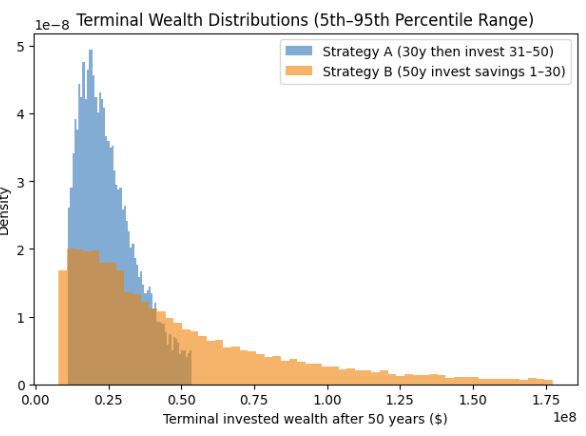
Across 20,000 simulated paths over a 50-year horizon, the median terminal invested wealth is approximately $23 million for the 30-year mortgage strategy (investing only after the mortgage is retired) and $36 million for the 50-year mortgage strategy (investing the monthly payment savings during the first 30 years).
Truncating the distributions to the 5th–95th percentile range for clarity, the 30-year strategy produces outcomes of roughly $11–54 million, while the 50-year strategy spans a much wider range of approximately $8–177 million.
The longer-duration mortgage therefore expands the dispersion of outcomes. The left tail is modestly worse, reflecting increased exposure to early-period market risk.
However, the right tail is substantially larger, driven by earlier and longer compounding of invested capital. The tradeoff is not between “paying less interest” and “paying more interest,” but between delaying investment and allowing compounding to operate over a longer horizon.
Houses Don’t Make People Rich, Finance Does
Residential real estate, evaluated on its own merits, is a mediocre asset. Long-run real returns are modest, idiosyncratic risk is high, and ownership carries substantial hidden costs that are often ignored in casual comparisons. The widespread belief that housing is a uniquely safe or superior investment survives largely because of misleading price charts.
What makes housing financially powerful is not the asset itself, but the structure of its financing. Mortgages provide unusually cheap long-duration leverage artificially depressed by government credit guarantees and further subsidized through the tax deductibility of interest. For households able to access this financing, mortgage debt can represent one of the lowest-cost sources of funding available in the economy, and in some cases function as effectively negatively priced capital after tax considerations.
This advantage is most valuable early in the life cycle. Young professionals with high expected income growth, or households with external support, face a fundamentally intertemporal problem: most of their earning power lies in the future, while asset prices are set today. In that context, longer-duration borrowing improves consumption smoothing and expands investable capacity. Failing to leverage in asset-heavy, equity-driven regions like San Francisco is often equivalent to remaining structurally underexposed to the dominant source of local purchasing power.
Housing does not make people wealthy because it is a great investment. It makes people wealthy because it is one of the only assets through which households are permitted and encouraged to borrow cheaply, at scale, and for decades. Understanding that distinction is the difference between mistaking the vehicle for the engine, and using the financial system as it actually exists.
Disclaimer
The information provided on TheLogbook (the “Substack”) is strictly for informational and educational purposes only and should not be considered as investment or financial advice. The author is not a licensed financial advisor or tax professional and is not offering any professional services through this Substack. Investing in financial markets involves substantial risk, including possible loss of principal. Past performance is not indicative of future results. The author makes no representations or warranties about the completeness, accuracy, reliability, suitability, or availability of the information provided.
This Substack may contain links to external websites not affiliated with the author, and the accuracy of information on these sites is not guaranteed. Nothing contained in this Substack constitutes a solicitation, recommendation, endorsement, or offer to buy or sell any securities or other financial instruments. Always seek the advice of a qualified financial advisor before making any investment decisions.