


Covered calls on indices and Boxes are two option strategies that mimic risky high-yield assets and treasury bills respectively but are tax-advantaged through section 1256 of the U.S. Internal Revenue Code. However, drawing current consumption from either liquidation of long-term capital gains or from margin is even more tax efficient. Running derivative income strategies (or indeed any other strategy) through an ETF result in additional tax benefits.
What You Pay for Derivative “Income”
The Economist ran an article a while ago about ETFs that systematically sell covered calls (the terminology they use is “buy-write” ETFs). To quote directly:
The trade-du-jour is the “buy-write” exchange-traded fund (ETF), a formerly obscure category that is now hoovering up capital. Since the start of 2023, buy-write ETFs have seen their assets balloon by 60%, to nearly $60 bn. In practice, such investors are buying baskets of stocks while selling (or “writing”) call options on them. These are contracts that give the buyer the right (though not the obligation) to buy the stocks for a set price (or “strike price”) in the future.
There is, of course, a catch:
Readers who do not believe in free lunches may sense a rather large catch coming. Yet it is not the familiar one applying to bets against market turbulence, which is that years of steady profits can be followed by a sudden, unexpected shock and a total wipe-out. A buy-write ETF may well fall in value, but in this respect it is no riskier than a corresponding “vanilla” fund that just owns the underlying stocks.
The real hitch is that, while such ETFs offer equity-like potential losses, their profits can never exceed the monthly income from selling options. Those profits thus resemble the fixed-income stream generated by a bond. They also up-end the logic for buying stocks in the first place: that a higher risk of losses, compared with bonds, is worth the shot at wild, uncapped returns. The nightmare scenario is that stocks go on a blistering bull run that buy-write investors miss out on, followed by a plunge that hurts them almost as much as everyone else.
The intuition for why selling covered calls for “income” may not always be a good idea is made even more clear by considering an extreme case. Assume the following:
You are long a biotech stock worth $100. Tomorrow there will be news on whether the firm’s only drug will be approved by the FDA. The stock is fairly priced because there is a 75% chance it will go to $0 and a 25% chance it will go to $400. You sell an at-the-money call (strike $100) for $50.
Did you earn “income” from selling this covered call?
A simple calculation shows you’ve just destroyed about $50 of expected value. While this example is contrived, the principle holds: option premium must be treated as compensation for risk, and there is a fair price for it that depends on the underlying’s volatility. To sell options below that theoretical fair value is literally handing cash bags to market makers.
We’re not ruling out the possibility that index options might be overvalued; however, given that passive buy-write investors are typically not price-sensitive (while market makers are), the long-run wealth transfer will favor market makers. The crowdedness of the buy-write strategy determines the transaction price—and thus the rate at which that aggregate wealth transfer occurs.
Downside Risk Justifies Equity Risk Premium
How much expectancy should covered call investors expect to lose? The answer is actually that they aren’t losing out on too much. A recent paper from AQR shows that most equity risk premium is derived from exposure to downside risk, and as such as encapsulated by a covered call structure. To show this, the authors split the returns of an S&P future into its covered call [on futures] and long call components
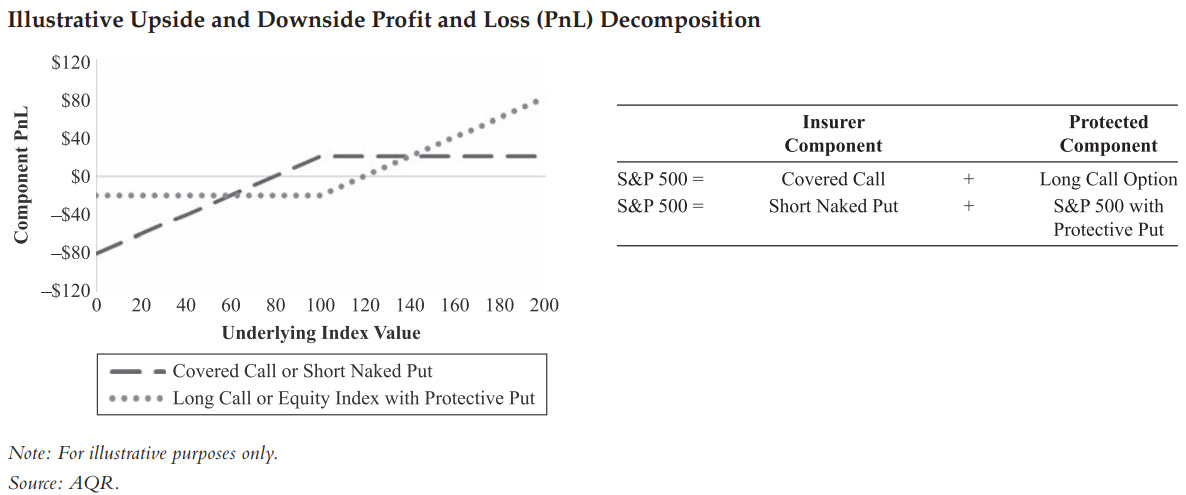
They then proceed to decompose the returns on S&P futures into their covered call and long call components using data from 1986-2014. The results show that premium in the covered call was high enough to account for the majority of returns.
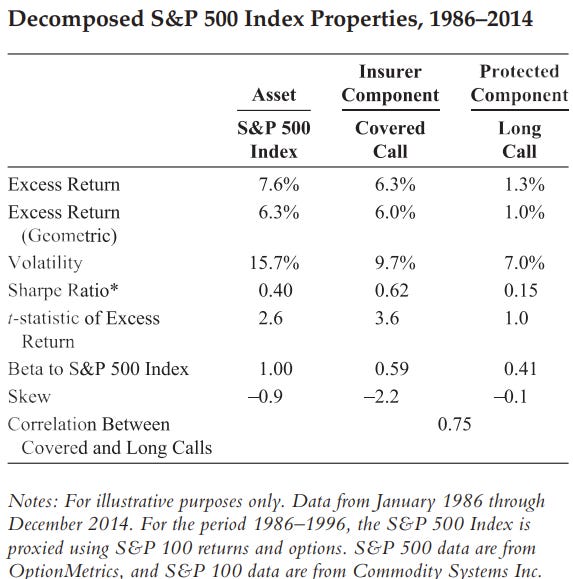
The reader may notice that the Sharpe ratio for the covered-call component is even higher than that of the underlying itself; however, due to the skew inherent in a covered-call payoff, the Sharpe ratio is not a reliable measure of risk-adjusted return. In fact, the long-run excess return and excess compounded return of covered calls are both lower than those of the underlying.
The gap in compounded returns between the covered calls and the underlying is smaller than the gap in their average excess returns, which aligns with our intuition that covered calls carry less risk and therefore suffer less from volatility drag.
Moreover, it is unlikely that the compounded returns of covered calls could ever exceed those of simply holding the underlying over the long run. By construction, total excess returns are conserved between a covered-call position and a long-call-plus-underlying position. Thus, for covered calls to outperform the underlying in excess returns, long-call excess returns would have to be negative (equivalently, put costs would have to exceed the stock’s excess returns). Such a scenario would imply that call-buyers possess risk-seeking utility (willing to pay for a product with negative expected excess returns) or that put-buyers are indifferent to paying more for insurance than the underlying’s expected excess return—neither of which is plausible in the long run.
Tax Advantages of Derivative Income (IRS Section 1256)
A Section 1256 contract, as defined in U.S. Code § 1256, includes—among other financial derivatives—regulated futures, currency swaps, and non-equity options (including index options). For U.S. federal income tax purposes, each Section 1256 contract is marked to market at the end of the tax year, and any gain or loss is treated as 40% short-term and 60% long-term, irrespective of the actual holding period.
Seeking income from investments rather than maximum growth can be prudent for individuals whose consumption needs exceed their regular income (e.g., retirees). This is especially true when access to margin loans is limited or expensive—using credit for spending can be more tax-efficient (more on this later).
Covered-call strategies offer significant advantages for income-seeking investors, both in tax treatment and diversification. Income from selling call options on broad-based indices often qualifies for the Section 1256 60/40 tax treatment, which can be more favorable than ordinary dividend income taxed at higher rates.
Moreover, covered calls let investors generate income across a much broader universe of stocks or index funds—not just dividend payers. Traditional dividend-focused portfolios tend to overweight defensive sectors (like utilities) and exhibit a value bias. By writing calls on a diversified index, investors maintain exposure to all sectors—including growth and momentum names that typically don’t pay dividends—thereby mitigating sector-specific and style risks and creating a more balanced, resilient income-generating portfolio.
Buy, Borrow, Die
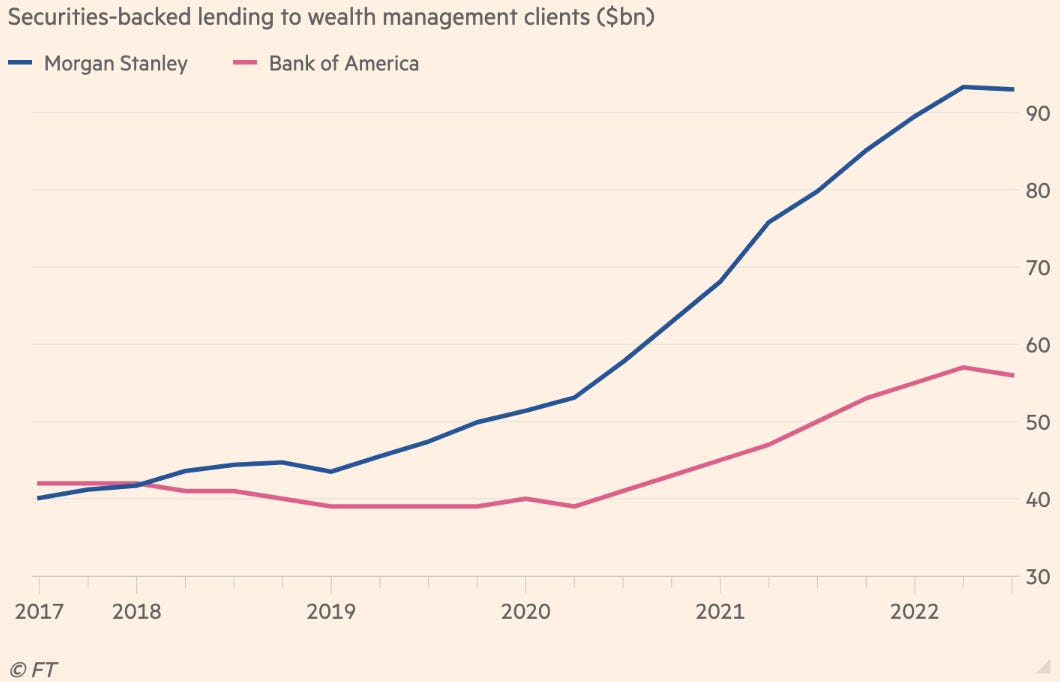
While derivative income is more tax-efficient than dividends, borrowing against a portfolio—often referred to as a “buy, borrow, die” strategy—can be even more tax-efficient for both current spending needs and wealth transfer purposes, particularly for individuals with substantial assets and access to favorable credit terms.
The primary tax advantage of this approach comes from avoiding capital gains taxes that would typically be incurred when selling appreciated assets to generate cash. Instead of selling assets, the investor borrows against their portfolio, using the securities as collateral. This borrowing doesn’t trigger a taxable event, allowing the underlying assets to continue appreciating without interruption. The interest on these loans may be tax-deductible, further enhancing the strategy’s tax efficiency.
Moreover, this allows the investor to take advantage of the step-up in basis at death. When assets are inherited, their cost basis is “stepped up” to the fair market value at the time of the original owner’s death (U.S. Code § 1014(a)). This means that all the capital gains that accrued during the original owner’s lifetime are essentially wiped out for tax purposes. Heirs can then sell these inherited assets immediately with little to no capital gains tax liability.
The “buy, borrow, die” approach also enables more effective charitable giving strategies. For instance, highly appreciated assets can be donated directly to charities, providing a tax deduction at full market value while avoiding capital gains taxes altogether. This can be more advantageous than selling assets, paying taxes, and then donating the after-tax proceeds.
It’s important to note that this strategy is most effective for those with significant assets and access to favorable borrowing terms. It requires careful management of debt levels and interest rates to ensure that the benefits outweigh the costs. Market downturns could lead to margin calls or reduced borrowing capacity. Therefore, it’s crucial to maintain a balanced approach and not over-leverage the portfolio. Despite these considerations, for those who can effectively implement it, the “buy, borrow, die” strategy offers perhaps the most powerful way to minimize taxes, maximize wealth transfer, and maintain financial flexibility throughout one’s lifetime.
Tax Advantages of ETFs (In-Kind Redemptions)
The “buy, borrow, die” strategy, while tax-efficient in many ways, does present challenges when it comes to portfolio rebalancing—especially when certain assets have grown disproportionately. Traditionally, investors often relied on mutual funds with high turnover or hedge funds with high fees, which frequently resulted in capital gains taxes due to liquidations. However, the emergence of exchange-traded funds (ETFs) has provided a solution through their unique structure, particularly their ability to use in-kind redemptions.
ETFs have demonstrated significant tax advantages over mutual funds. In 2018, per a Goldman Sachs report, 61% of mutual funds distributed capital gains to investors, compared to only 10% of ETFs. The difference in the magnitude of these distributions is even more striking: mutual funds paid out an average of 4.5% of their net asset value (NAV) as capital gains, while ETFs paid out a mere 0.2%. This represents a remarkable level of tax efficiency for ETFs.
We note that this is not purely due to the tax structures of the two vehicles, but also partly due to the passive nature of most ETFs. While only 4% of mutual funds are passive, a whopping 89% of ETFs follow passive strategies, which naturally reduces the frequency of selling securities at a gain and thus lowers the potential for capital gains distributions to shareholders.
However, ETFs are most certainly tax-efficient in their use of in-kind redemptions. In the primary market, ETF issuers can satisfy redemptions and portfolio rebalances by exchanging securities for ETF shares, rather than selling securities for cash. This in-kind activity does not trigger a taxable event for the fund (U.S. Code § 852(b)(6) Exemption Rule), effectively shielding shareholders from capital gains that might arise from other shareholders’ buying and selling. Indeed, approximately 90% of ETF trades occur between market participants on exchanges, without affecting the underlying portfolio. This is in stark contrast to open-end mutual funds, where all activity takes place in the primary market and directly impacts the fund’s holdings. That structural difference significantly reduces capital flows in and out of the ETF at the fund level, thereby minimizing potential capital gains distributions.
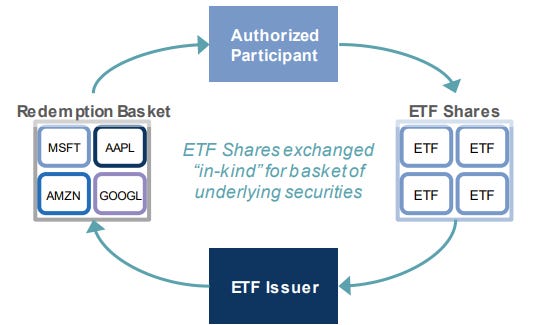
The unique structure of ETFs creates a symbiotic relationship between fund managers, arbitrageurs, and market makers. This relationship centers on the creation/redemption process, in which arbitrageurs and market makers constantly monitor for price discrepancies between an ETF and its underlying basket of securities. When they spot a mismatch, they engage in arbitrage—creating or redeeming ETF shares to capture the difference. This process serves two critical functions: it keeps the ETF’s market price closely aligned with its net asset value (NAV), ensuring fair pricing for all investors; and it facilitates in-kind creations and redemptions, which allow for portfolio rebalancing and large inflows or outflows without triggering capital gains taxes for shareholders.
In effect, the profit-seeking behavior of arbitrageurs and market makers provides a valuable service to ETF managers and investors alike: maintaining market efficiency while preserving the tax advantages that make ETFs so attractive. This mechanism illustrates how the interests of different market participants can align to create a more efficient, tax-friendly investment environment.
How much tax do ETFs save investors? Estimating this precisely is difficult, but here’s an upper-end approximation. With approximately $9 trillion invested in ETFs, if they distributed capital gains at rates similar to mutual funds—around an extra 4% of NAV annually—that would imply roughly $360 billion in additional capital gains taxes, or about 8% of total federal tax revenue. Of course, this staggering figure reflects both the lower turnover of passive strategies and the unique in-kind redemption mechanism that enables tax-efficient rebalancing.
Money in the BOXX / T-Bills Without Tax Bills
If options are good for reducing taxes, and ETFs are good for reducing taxes, then combining them certainly amplifies the benefit. Enter the BOXX ETF (Alpha Architect 1–3 Month Box ETF), which leverages a sophisticated options strategy to offer investors a tax-efficient alternative to traditional money market funds. Matt Levine dubbed it “the poster child for tax arbitrage.”
BOXX’s core strategy is the box spread. Here’s Levine’s illustrative example:
You buy a put and sell a call, both at a $105 strike, at net cost zero.
You sell a put and buy a call, both at a $55 strike, at net cost $47.60.
In one year, regardless of where the stock trades, one side exercises and the other side offsets it, leaving you with exactly $50 and no stock.
Since you paid $47.60 today and receive $50 in a year, you’ve effectively earned a 5% yield on your investment.
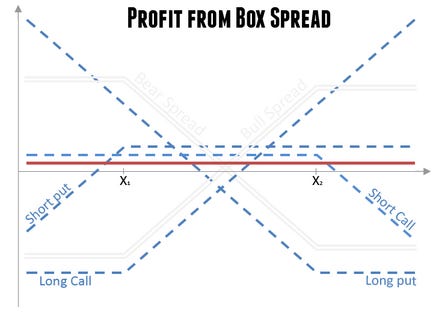
BOXX goes a step further. When it builds a box spread, the individual option legs can show large paper gains or losses—even though the aggregate position is nearly neutral. To harvest tax losses, BOXX uses in-kind redemptions: it transfers the winning legs to an arbitrageur (generating a realized loss for the fund) while retaining the losing legs. Economically, nothing has changed, but the fund (and its shareholders) lock in a tax loss without giving up any real value.
This lets BOXX deliver Treasury-like yields without ordinary-income tax drag. Normally, interest from T-bills or money market funds is taxed as regular income—up to 37% for top earners. BOXX’s structure converts that into long-term capital gains or losses. Today, this is only practical for very short maturities (1–3 months), because longer-dated box spreads require liquid options markets that don’t yet exist. If reliable 5-, 7-, or 10-year options on major indices (like the S&P 500) became available, similar funds could offer multi-year yields with the same tax efficiency. In a high-rate environment, that could revolutionize fixed-income allocations—locking in attractive long-term rates without annual tax liabilities.
Money in the Margin
The increasing availability of credit to a broader range of investors is democratizing access to sophisticated tax-management strategies that were once exclusive to ultra-high–net-worth clients. High-end private-wealth managers typically require $5 million to $10 million of investable assets to offer “buy, borrow, die” and similar bespoke solutions.
Today, platforms like Robinhood extend overnight margin rates approaching 5.5% annualized even to modest account sizes. That means strategies once reserved for the top 0.01% ($30 million+ in investable assets) or 0.05% ($10 million+) are now within reach of the top 1% ($5–7 million) and even the top 5% (~$1 million). By lowering credit-access thresholds, retail investors can harness tax-efficient borrowing techniques that previously required six- or seven-figure minimums, effectively spreading these benefits much more widely across the wealth spectrum.
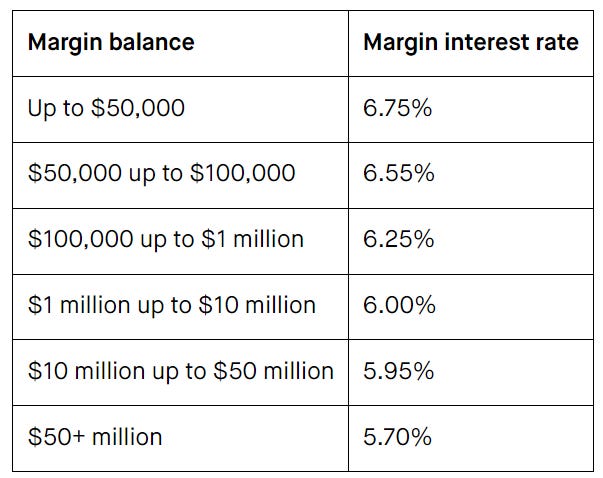
Traditionally, “buy, borrow, die” was primarily utilized by individuals with substantial wealth who could easily access low-cost credit secured by their large portfolios. This approach lets them avoid realizing capital gains by borrowing against appreciated assets instead of selling them, effectively deferring taxes indefinitely.
As brokerages now offer competitive margin rates even for smaller portfolios, these tax-deferral strategies are becoming more widely available. More investors can consider using borrowed funds for living expenses or new investments—rather than selling appreciated assets and triggering capital gains taxes. This shift may increase demand for tax-efficient products like BOXX or other specialized ETFs designed to minimize current tax liabilities. It could also spur further innovation—new ETF structures, more sophisticated robo-advisors incorporating tax strategies, or revamped advisory practices—to help a broader range of investors manage their taxes more effectively.
Taking it Further
Blockchain and DeFi unlock the ability to spin up fully bespoke derivatives in minutes rather than months. A covered-call-like strategy can be codified as an on-chain option vault with transparent, deterministic pay-offs and scheduled coupon distributions. Those coupons can flow directly into yield-bearing stablecoin protocols, compounding seamlessly without human intervention or counterparty risk.
Retirees or income-seeking investors simply deposit their tokens, collect predictable monthly payments, and, if desired, borrow stablecoins against their collateral at near‐zero funding spreads—since the pool is over-collateralized and all underwriting logic lives in immutable smart contracts. Fully on-chain lending removes the need for banks’ compliance overhead, credit committees, and legacy IT systems. Code‐enforced collateral rules and transparent liquidation mechanics let users access “risk-free” loans at rates commensurate with the protocol’s governance parameters—often below what even the best institutional lenders can offer. That means an individual with $100 k of tokenized yield-generating notes can pledge them to borrow $50 k in stablecoins, pay minimal interest, and continue to earn their structured-product coupons undisturbed.
Tokenized funds mirror ETFs on chain but with infinite composability: any protocol can mint, bundle, or slice exposure to equities, fixed income, commodities, or private-market instruments into bespoke tranches. Because ownership transfers happen via token swaps rather than corporate share registry updates, no taxable event is triggered on redemption or rebalancing. Investors can defer gains forever, or simply swap into another tokenized strategy without ever realizing a taxable sale—delivering all the familiar tax efficiencies of traditional structures plus radically expanded choice.
Perhaps most powerful is the pace of innovation. In TradFi, launching a new “tax trick” or compensation structure requires legions of lawyers, compliance reviews, and board approvals; on a public blockchain, any developer or DAO can deploy a new yield strategy, governance token, or vesting schedule permissionlessly. Composability means that once one project proves out an on-chain tax wrapper or income stream, every other protocol can integrate that logic within hours—propagating best practices at web-speed rather than bureaucratic pace.
In this way, DeFi stands to democratize not just access to structured income, but the very engineering of financial products themselves.
Disclaimer
The information provided on TheLogbook (the "Substack") is strictly for informational and educational purposes only and should not be considered as investment or financial advice. The author is not a licensed financial advisor or tax professional and is not offering any professional services through this Substack. Investing in financial markets involves substantial risk, including possible loss of principal. Past performance is not indicative of future results. The author makes no representations or warranties about the completeness, accuracy, reliability, suitability, or availability of the information provided.
This Substack may contain links to external websites not affiliated with the author, and the accuracy of information on these sites is not guaranteed. Nothing contained in this Substack constitutes a solicitation, recommendation, endorsement, or offer to buy or sell any securities or other financial instruments. Always seek the advice of a qualified financial advisor before making any investment decisions.