


A mortgage is a loan with an option [to refinance] attached. Higher interest rates increase the underlying cost of borrowing, but they can also increase the size of potential future rate movements, making the borrower’s right to refinance more valuable. The investor financing the mortgage is on the other side of that option. When providing it becomes more expensive, investors require additional compensation as an increased spread.
The Prepayment Option
Consider a U.S. fixed-rate residential mortgage that allows prepayment without a penalty (by law they are obligated to after year 3). Suppose you borrow at 6%.
If mortgage rates rise to 8%, you keep paying 6%. The lender generally cannot make you replace your loan with a more expensive one. If mortgage rates fall to 4%, you may be able to refinance, repay the original lender, and lower your interest expense.
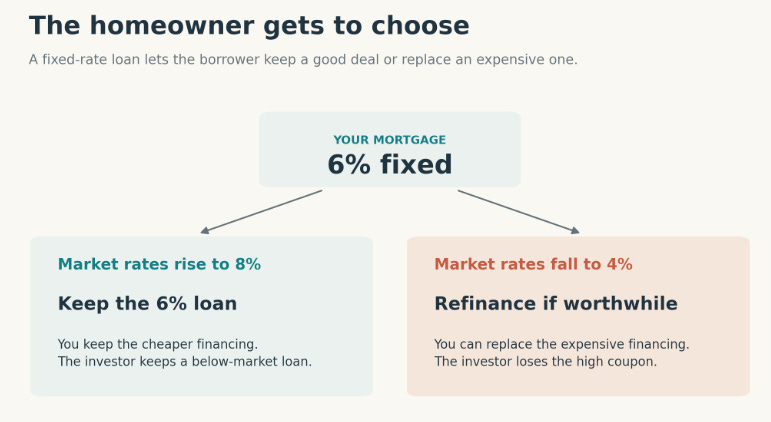
You can keep the contract when it benefits you and replace it when a better one becomes available. The investor has the opposite experience. An attractive high-coupon loan may disappear when rates fall, and an unattractive low-coupon loan may remain outstanding when rates rise.
This flexibility has a price, so the right to prepay is valuable to the homeowner and is reflected in the mortgage rate. A useful valuation identity is:
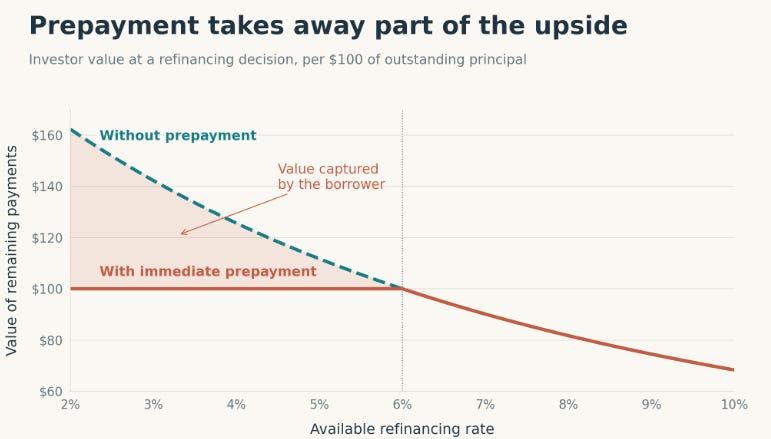
Volatility & Option Pricing
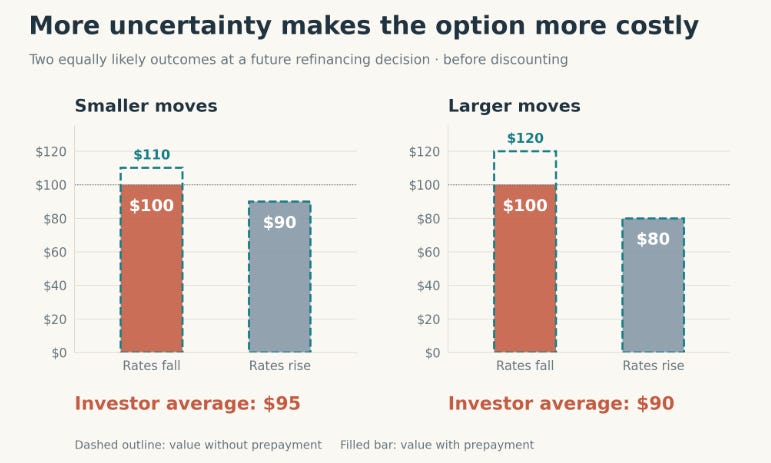
Imagine that, at a future refinancing decision, a loan has $100 outstanding.
Without prepayment, its remaining payments could be worth either $110 or $90, with equal probability (depending on the path of rates). With perfect prepayment, the investor gets $100 in the favorable state with the borrower repaying the loan. In the unfavorable state, the investor retains a loan worth $90.
The average for the investor in the above case is therefore $95.
Now increase the uncertainty. The remaining payments could instead be worth $120 or $80. The investor’s favorable outcome is still limited to $100, while the unfavorable outcome falls to $80.
The average is now $90 for the investor.
Before accounting for the option, the average was $100 in both examples. Greater dispersion made the investor worse off because the borrower captured the additional upside while being shielded from the downside by the option.
That asymmetry is one of the reasons why mortgage rates are higher than treasury rates even though agency-backed mortgages are implicitly insured by the US government. The investor needs additional compensation through the higher rate precisely because of the cost of the refinancing option that they are short.
Rates & Rates Volatility
Rates level and rates volatility are typically not independent, and their relationship is one of the most widely studied in macroeconomics.
In general, the instantaneous relationship between rates and volatility depends on what investors fear. Inflation scares can push yields and volatility up together. Recession scares can push yields down while volatility rises.
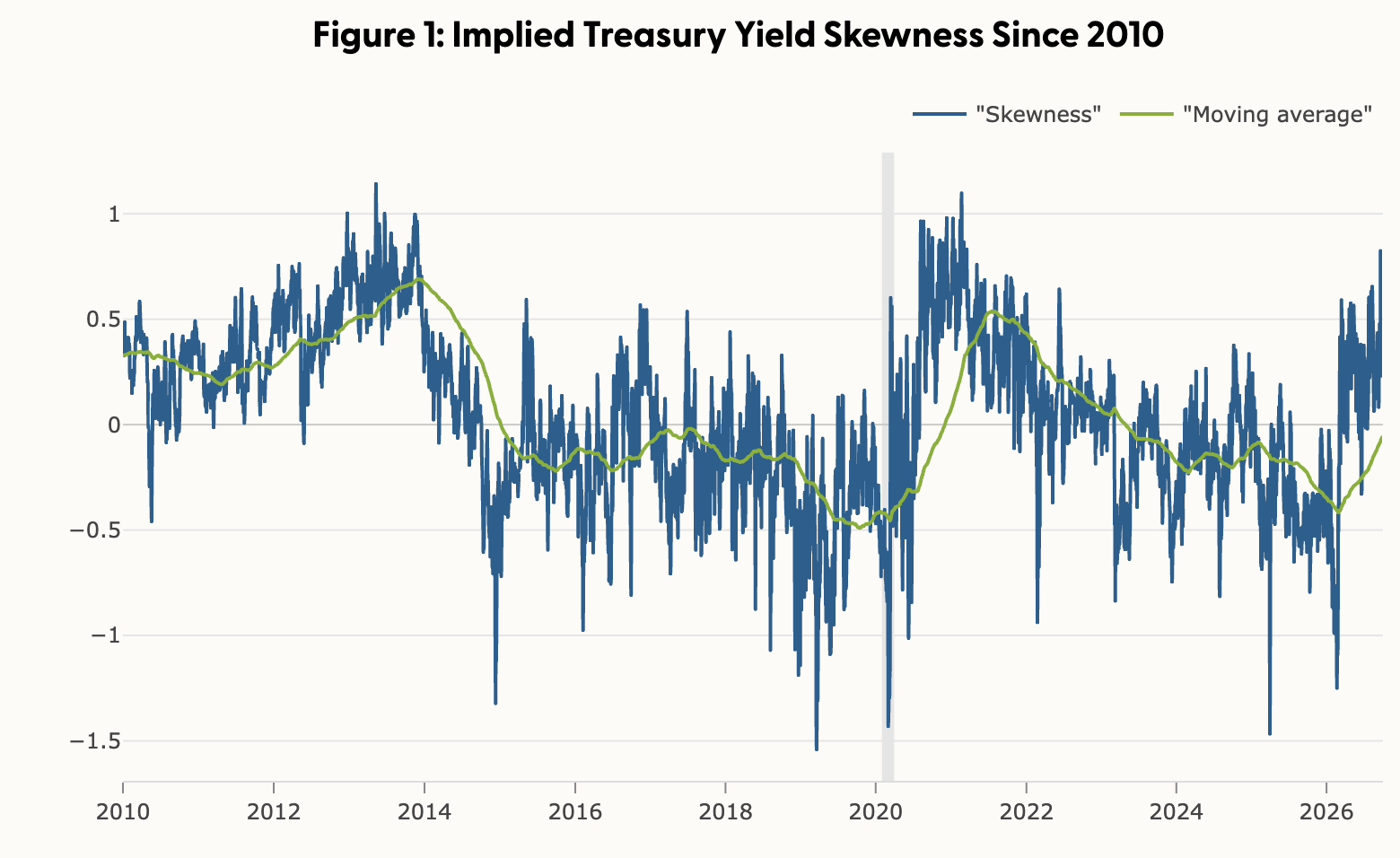
During an inflation scare, investors worry about tighter monetary policy and a bond selloff. Demand for Treasury futures puts can increase, making protection against falling bond prices relatively expensive. This produces negative price skew, corresponding directionally to positive yield skew.
During a recession scare, investors seek safety and anticipate rate cuts. Treasury futures calls can become relatively expensive as investors position for rising bond prices and falling yields. This produces positive price skew, corresponding directionally to negative yield skew.
During the past few years, long duration instruments have often exhibited more implied positive rate-vol correlation than short duration instruments (per derivatives market). There is no commonly agreed cause but plausible arguments are:
Inflation Uncertainty and Risk Premia: Long-term interest rates decompose into long-term growth and inflation expectations as well as term premium (the extra compensation investors demand for holding long-maturity bonds). When inflation or economic growth becomes harder to forecast, macro volatility rises, which drives up both rates volatility and the term premium.
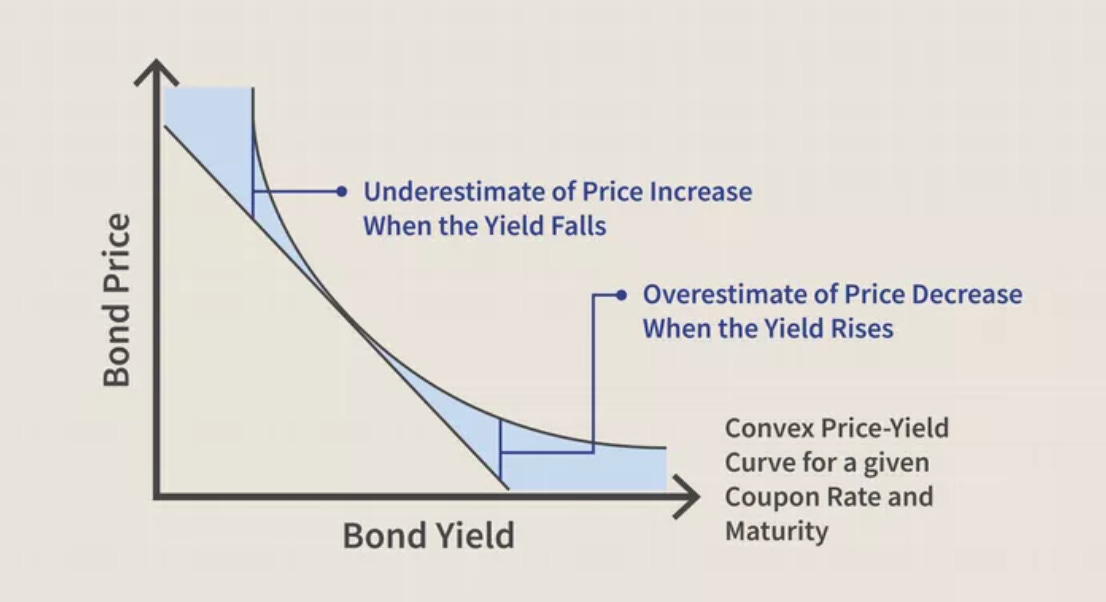
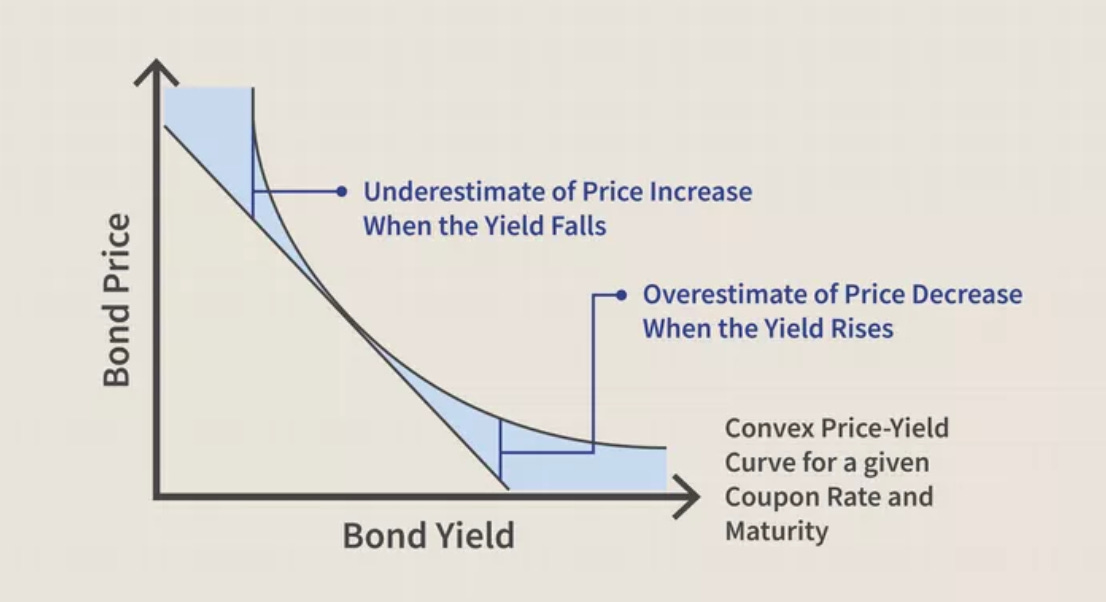
The Convexity Effect: Long-maturity bonds have high price sensitivity (duration) and non-linear price responses to rate changes (convexity). When interest rate volatility is high, the value of this optionality/convexity shifts, and models of the term structure show that higher yield volatility directly increases the average yield required by investors.
Rate Volatility to Rate Spread
Imagine a simplified refinancing option with one exercise date. The borrower benefits if the future refinancing rate falls below a threshold:
For a normally distributed rate, when the forward rate equals the threshold, the option cost expressed in equivalent spread units is:
Here, N is the notional, A is the present-value annuity factor per unit of notional, and T is the time to exercise in years. Dividing the option price by N times A converts a dollar premium into a recurring-rate equivalent.
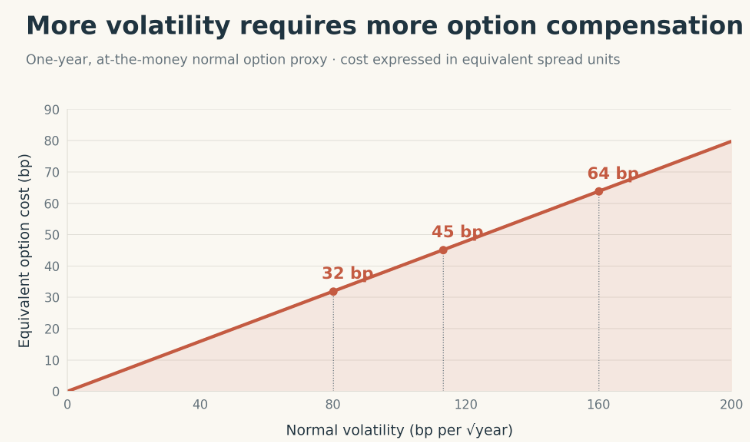
In a one-year, at-the-money Bachelier option proxy, equivalent option cost is approximately 0.40 times normal volatility. Increasing volatility from 80 to 113 to 160 basis points raises the cost from roughly 32 to 45 to 64 basis points.
Calibrated & Hypothetical Example
In an inflation-driven regime (such as today’s), we can assume a positive correlation between rate and volatility shocks (see empirical skewness below).
Consider a one-year option on a 30-year swap, with a starting forward rate of 4% and an assumed at-the-money Black volatility of 25%.
Using SABR set beta to 0.5, the rate–volatility correlation to +0.50, and volatility of volatility to 0.60, with alpha calibrated to approximately 0.04157.
In this example, a 25-basis-point increase in both the benchmark and forward rate raises the mortgage rate by approximately 29 basis points.
If liquidity deteriorates sharply in interest-rate options markets, the cost of hedging mortgage prepayment risk can surge, pushing mortgage rates up faster than Treasury.
Suppose Treasury yields rise from 5% to 7%, the relevant forward rate follows, and stressed option pricing lifts annualized implied yield volatility from 100 to 300 bps.
Our simplified one-year option proxy would widen an initial 2% mortgage spread to roughly 3%, taking the mortgage rate from 7% to about 10%.
Summary
Mortgage rates reflect both the cost of borrowing and the value of the borrower’s right to refinance. Greater rate uncertainty generally makes that flexibility more expensive, increasing the compensation mortgage investors require.
The relationship depends on the economic regime. Inflation fears can push yields and volatility higher together, while recession fears can raise volatility as yields fall. In stressed markets, poor liquidity and more expensive hedging can widen mortgage spreads further.
Disclaimer: The information provided on TheLogbook (the “Substack”) is strictly for informational and educational purposes only and should not be considered as investment or financial advice. The author is not a licensed financial advisor or tax professional and is not offering any professional services through this Substack. Investing in financial markets involves substantial risk, including possible loss of principal. Past performance is not indicative of future results. The author makes no representations or warranties about the completeness, accuracy, reliability, suitability, or availability of the information provided.
This Substack may contain links to external websites not affiliated with the author, and the accuracy of information on these sites is not guaranteed. Nothing contained in this Substack constitutes a solicitation, recommendation, endorsement, or offer to buy or sell any securities or other financial instruments. Always seek the advice of a qualified financial advisor before making any investment decisions.