

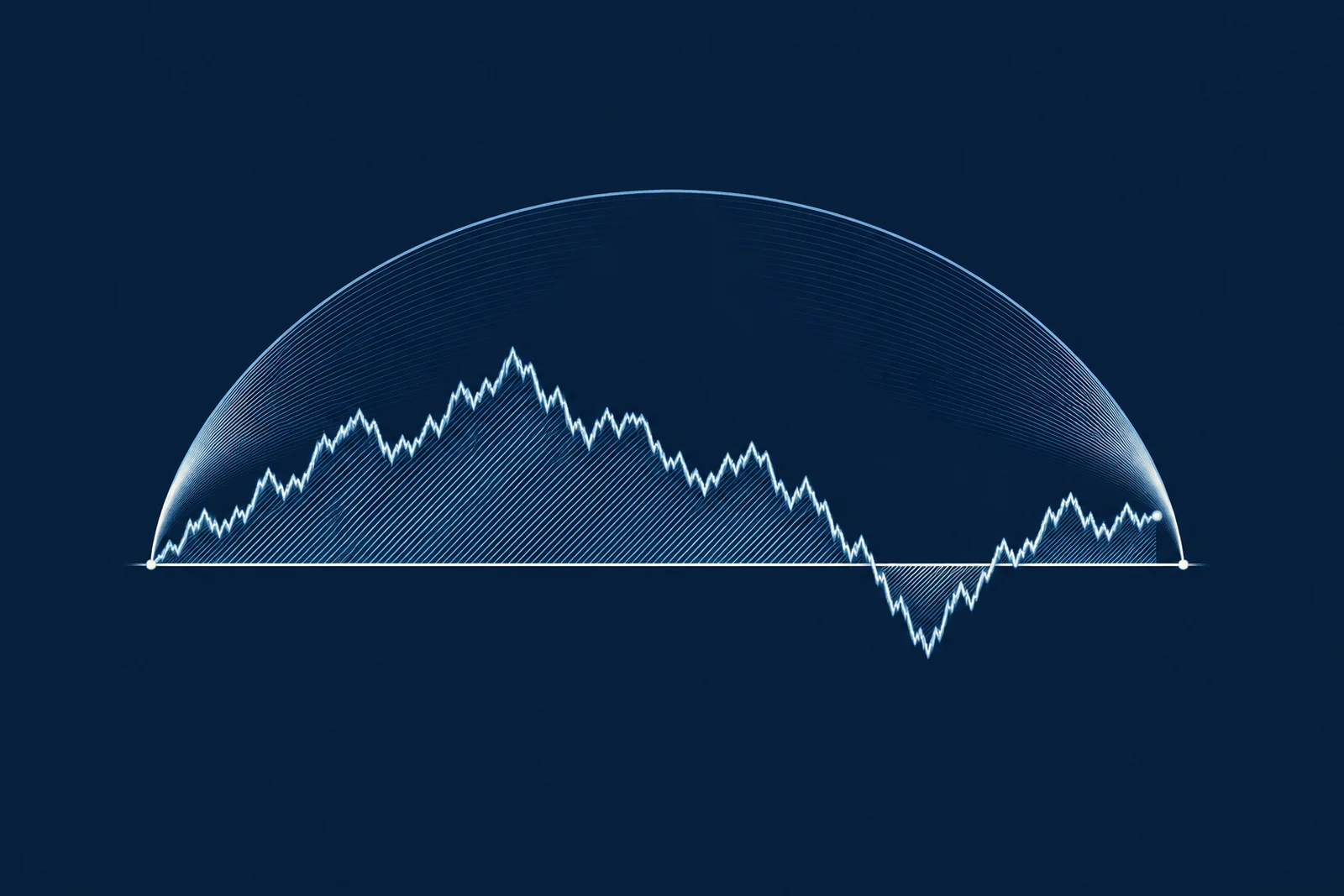
Levy’s three arcsine laws describe counterintuitive behaviors in random walks: (1) the proportion of time spent on one side of a starting point (above or below zero) skews towards extreme values (2) the time of peak displacement from the starting point is most likely to occur near the beginning or end of the walk rather than in the middle; and (3) the last crossing of the starting point tends to occur either early or late in the walk, not in the middle. Implications to fair games and investments, which can be modeled with random walks, abound.
Gauging Intuitions
Consider the following questions, and respond to them using your intuition (no math):
(1) Players A and B of EQUAL skill are playing a game for 100 rounds where the winner of each round gets 1 point and the rounds are played independently. I inform you that one of the players leads (has more points than the other player) x% of the time, is it more likely for x to be in the interval (1) 0% to 25% (2) 25% to 75% or (3) 75% to 100%?
(2) Two teams of EQUAL skill are playing a game that lasts 100 minutes. Assuming that points are scored uniformly across this time, and letting x be the LAST time that the winning team overtook the losing team, is it more likely for x to be in the interval (1) 0 to 25 minutes (2) 25 to 75 minutes or (3) 75 to 100 minutes?
(3) I am bored and I flip for $100 with a friend who is also bored (and who also has a risk-seeking utility curve) using a FAIR coin. We do this over 100 times (a total of $10,000 wagered). Assume I achieve my maximum wealth at time x, is it more likely for x to be in the interval (1) 0th to 25th flip (2) 25th to 75th flip or (3) 75th to 100th flip?

The Arcsine Laws
Probability can often be counter-intuitive; in the words of William Feller (the professor for whom the term “proof by intimidation” was coined):
“[In probability] we encounter theoretical conclusions which not only are unexpected but actually come as a shock to intuition and common sense. They will reveal that commonly accepted notions concerning chance fluctuations are without foundation and that the implications of the law of large numbers are widely misconstrued. For example, in various applications it is assumed that observations on an individual coin-tossing game during a long time interval will yield the same statistical characteristics as the observation of the results of a huge number of independent games at one given instant. This is not so...Contrary to popular opinion, it is quite likely that in a long coin-tossing game one of the players remains practically the whole time on the winning side, the other on the losing side.” (Chapter 3)
In particular, we note that the score difference between two equally matched teams / players in a fair game can be modeled by a random walk. The solutions to the questions given can be given by (1) the proportion of times that the walk is positive (2) the most recent time that the walk changed sign and (3) the time the walk achieves its maximal value. What is perhaps surprising is that for a discrete random walk (of 100 steps in our case) the distributions of these 3 random variables are the same; in addition, for an infinitesimal random walk from 0 to 1 the distribution of these 3 random variables is given by the arcsine distribution with the CDF
and associated PDF
These statements are known as the Arcsine Laws and are typically attributed to Paul Lévy. The proof (a bit involved) can be found here.
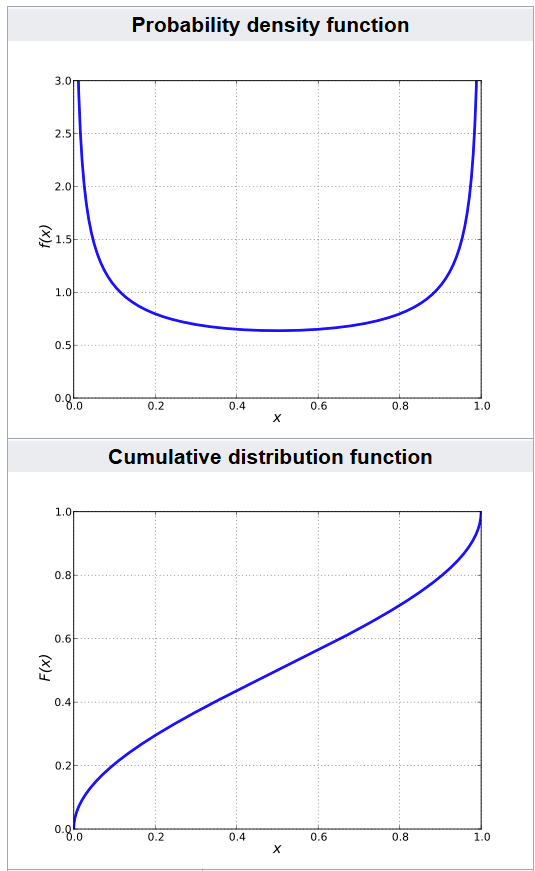
We note that arcsin(1/2) = pi/6 so F(0.25) = 1/3. By symmetry this means that in all 3 of the questions given, the intervals 0 to 25, 25 to 75, and 75 to 100 all have roughly the same probabilities of containing the correct answer. Using the arcsine law, we can make some other counter-intuitive, but nonetheless correct statements, such as:
In a long sequence of coin flips, the probability that heads leads 85% of the time is about 1/4. This means that in over 50% of evenly matched games, one team will lead for at least 85% of the time. Merely observing that one team is leading 85% of the time, without other information, is NOT a strong indicator for that team being better.
Consider an investment with a positive net return 75% of the time. This has a 33% chance of happening even if the investment’s returns follow a random walk with mean zero. Observing the proportion of time an investment is above a benchmark is therefore not necessarily a great indicator of investment performance.
Games where the teams are evenly matched, statistics on leads must follow the arcsine law, this means that lead changes are most likely at the beginning and end of games and less likely in the middle, so “comebacks” are not unexpected.
If all traders at a firm are equally capable but have some randomness in performance, it is not at all surprising for one trader to maintain the highest overall PnL and another the lowest overall PnL for the vast majority of the year.
Erdős Arcsine Law
The arcsine law also appears (surprisingly) in the statistical properties of prime factors. The proof (even more involved) for the following can be found here.
For any natural number n we can write its prime factorization as
Define a factor p_i to be small if log log p_i < i, that is to say a prime factor p_i is small if the natural log of the natural log of p_i is strictly less than its index i. Define also s_n = |{1 ≤ i ≤ k : p_i is a small prime factor of n}|, that is to say s_n is the number of small prime factors of n. Then, it can be shown that
That is, s_n / log log n behaves like an arcsine distributed random variable.
Disclaimer
The information provided on TheLogbook (the "Substack") is strictly for informational and educational purposes only and should not be considered as investment or financial advice. The author is not a licensed financial advisor or tax professional and is not offering any professional services through this Substack. Investing in financial markets involves substantial risk, including possible loss of principal. Past performance is not indicative of future results. The author makes no representations or warranties about the completeness, accuracy, reliability, suitability, or availability of the information provided.
This Substack may contain links to external websites not affiliated with the author, and the accuracy of information on these sites is not guaranteed. Nothing contained in this Substack constitutes a solicitation, recommendation, endorsement, or offer to buy or sell any securities or other financial instruments. Always seek the advice of a qualified financial advisor before making any investment decisions.