


The core theoretical results in this post comes from the paper Has the U.S. Finance Industry Become Less Efficient? by Philippon (2014).
Introduction
In 1886, a depositor at a New York commercial bank paid the financial system about $0.019 per year for every dollar of intermediated assets, between savings stored, credit extended, equity issued, and payments cleared. The same dollar, routed through the 2012 financial system, with index funds, securitization, repo, high-frequency trading, securitized credit cards, and interest rate swap dealers, cost about $0.018. A century and a quarter of compounding technological progress in one of the most competitive industries in the world has NOT brought down the net cost of intermediation.
Per the author’s own words in the abstract for Has the U.S. Finance Industry Become Less Efficient? the core empirical results show that:
A quantitative investigation of financial intermediation in the U.S. over the past 130 years yields the following results : (i) the finance industry’s share of GDP is high in the 1920s, low in the 1960s, and high again after 1980; (ii) most of these variations can be explained by corresponding changes in the quantity of intermediated assets (equity, household and corporate debt, liquidity); (iii) intermediation has constant returns to scale and an annual cost of 1.5% to 2% of intermediated assets; (iv) secular changes in the characteristics of firms and households are quantitatively important.
Defining The Cost of Financial Intermediation
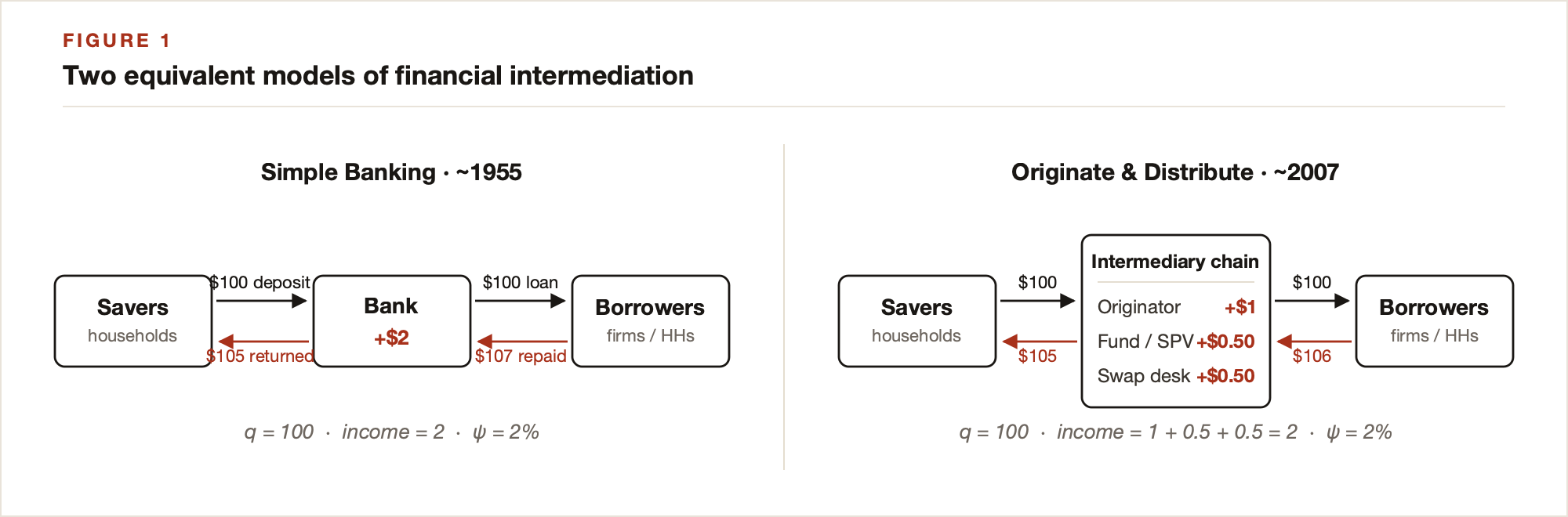
Imagine the entire financial sector as a black box. Money goes in from savers; money comes out to borrowers and equity issuers. The black box collects a toll for its trouble. That toll is the income of the finance industry: every fee, every spread, every wage, every bonus, every trading profit. From the outside, you don’t need to know whether the toll was collected by a bank net interest margin, an asset-management fee, an IPO underwriting spread, or a swap-desk markup. You just need the total.
In equilibrium, then, the user cost of external finance to a borrower or investor decomposes cleanly:
The borrower’s cost of capital is what the saver demands, plus a wedge the intermediary keeps. The wedge ψ can be estimated as a ratio:
The numerator is finance-industry value added (labor income + capital profits). The denominator is the dollar volume the system services, measured on the balance sheets of end users who are not banks, so that interbank lending doesn’t double-count.
The quantity in the denominator is the sum of the three economically meaningful things the financial system actually produces for non-financial agents:
Add up what the system charges and divide by what it services gets us the price per unit of finance, comparable across centuries. Every other measure such as bid-ask spreads, mutual-fund expense ratios, and lowering brokerage commissions, only captures one product at one moment and misses the rest of the iceberg.
Core Empirical Results
The two relevant long-run series from the BEA are finance value added which goes back to 1880., and intermediated assets which goes back to 1886.
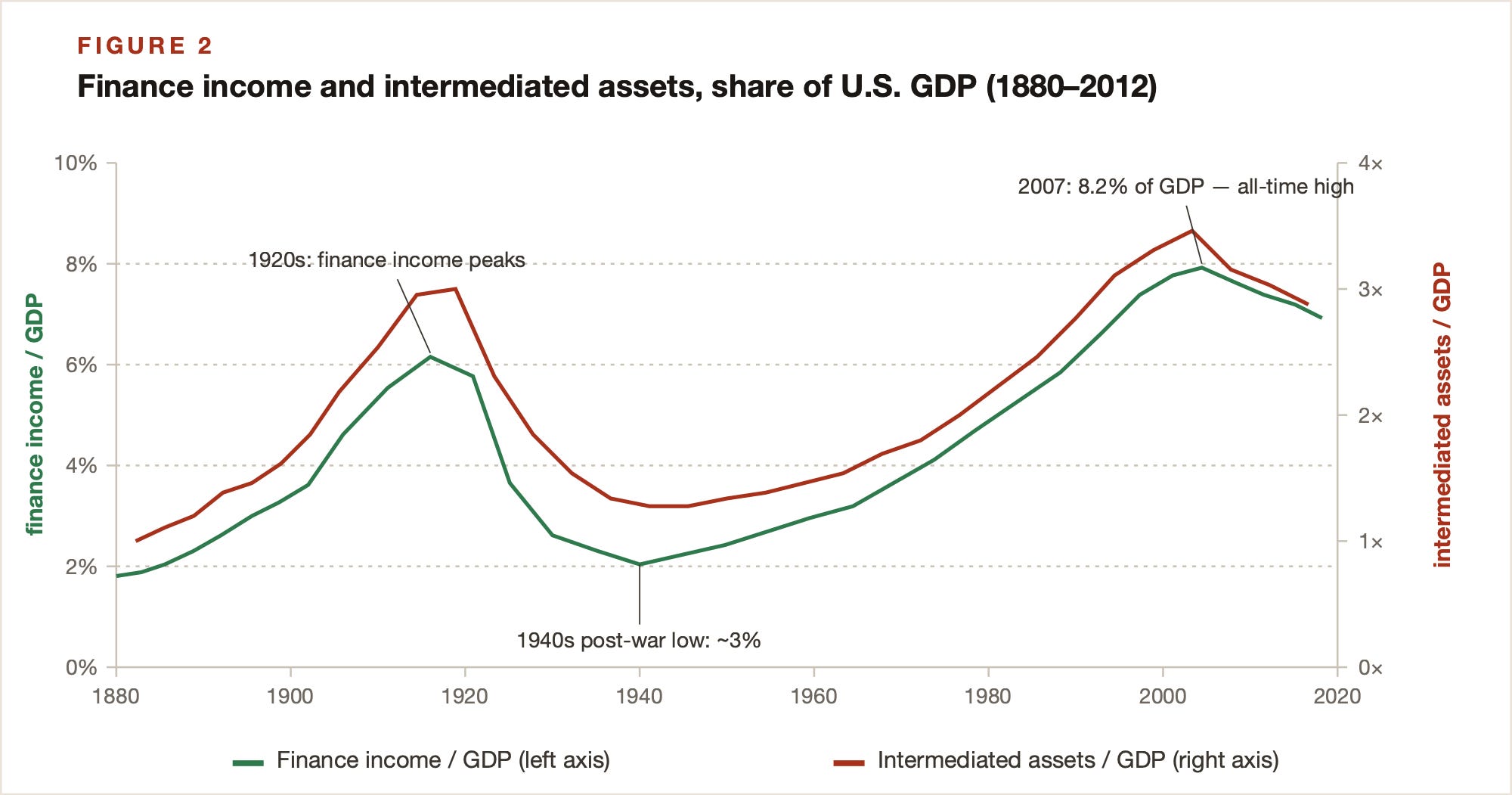
The income series tells the story that laypeople already know: finance is huge again. From the post-war trough of 3% of GDP to a 2007 peak of 8.2%. Doubled relative to the rest of the economy in a single human lifetime. But notice that the red line, intermediated assets, moves in lockstep with the green line. Finance got big because the things finance services got big: corporate equity values, household debt, repo markets. Per dollar serviced, the system charged about the same.
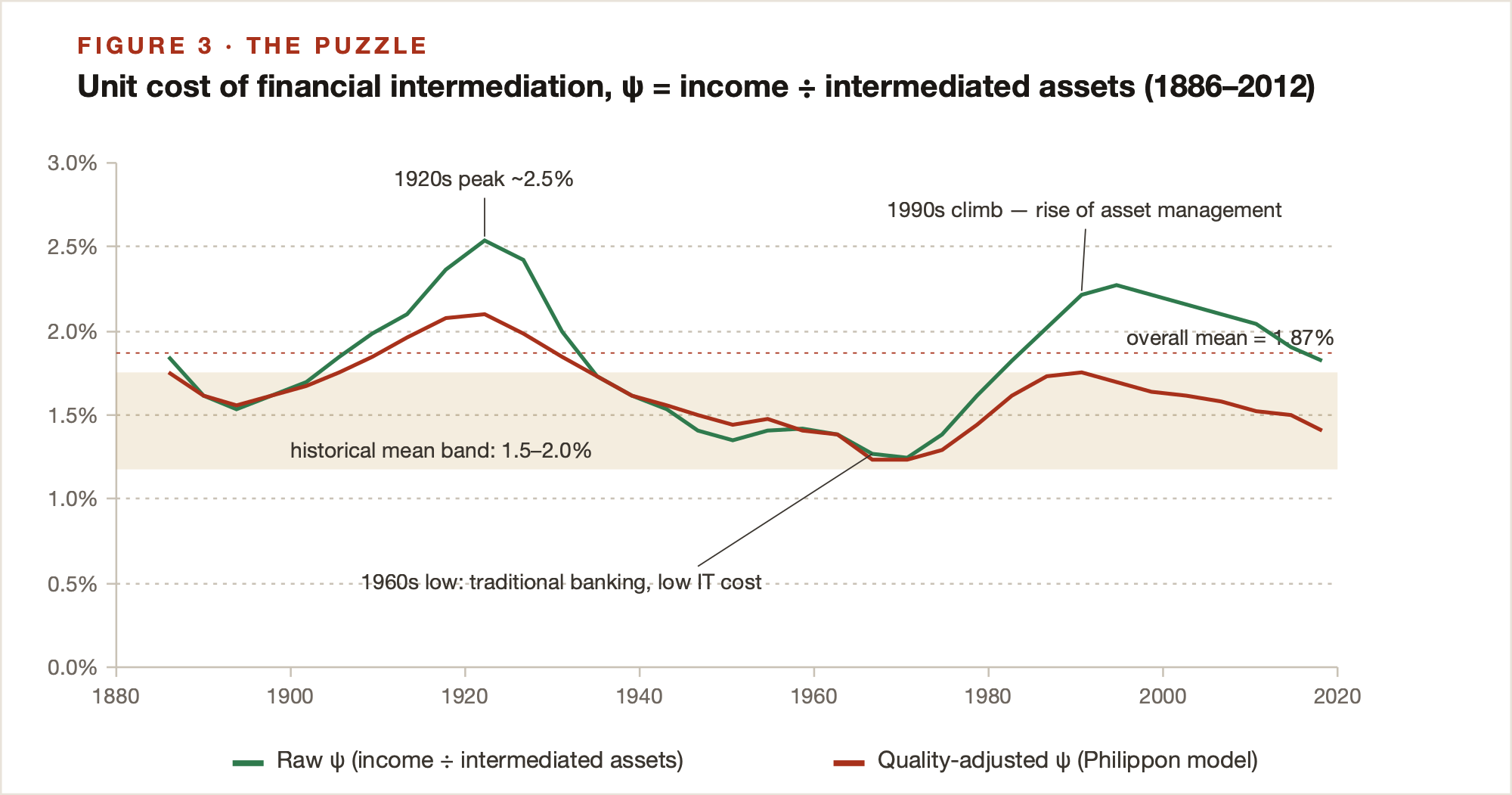
The unit cost refuses to fall over the long run. It rises in the 1920s, falls back to ~1.4% in the 1960s, then climbs again from 1980 onward. The quality-adjusted line (red), which corrects for the fact that the modern system services riskier borrowers (more young firms, more low-income households) per dollar of credit, is flatter still.
In short, the unit cost of intermediation is about as high today as it was at the turn of the 20th century. Improvements in information technologies do not appear to have led to a significant decrease in the unit cost of intermediation. Explaining this puzzle is an active area of research.
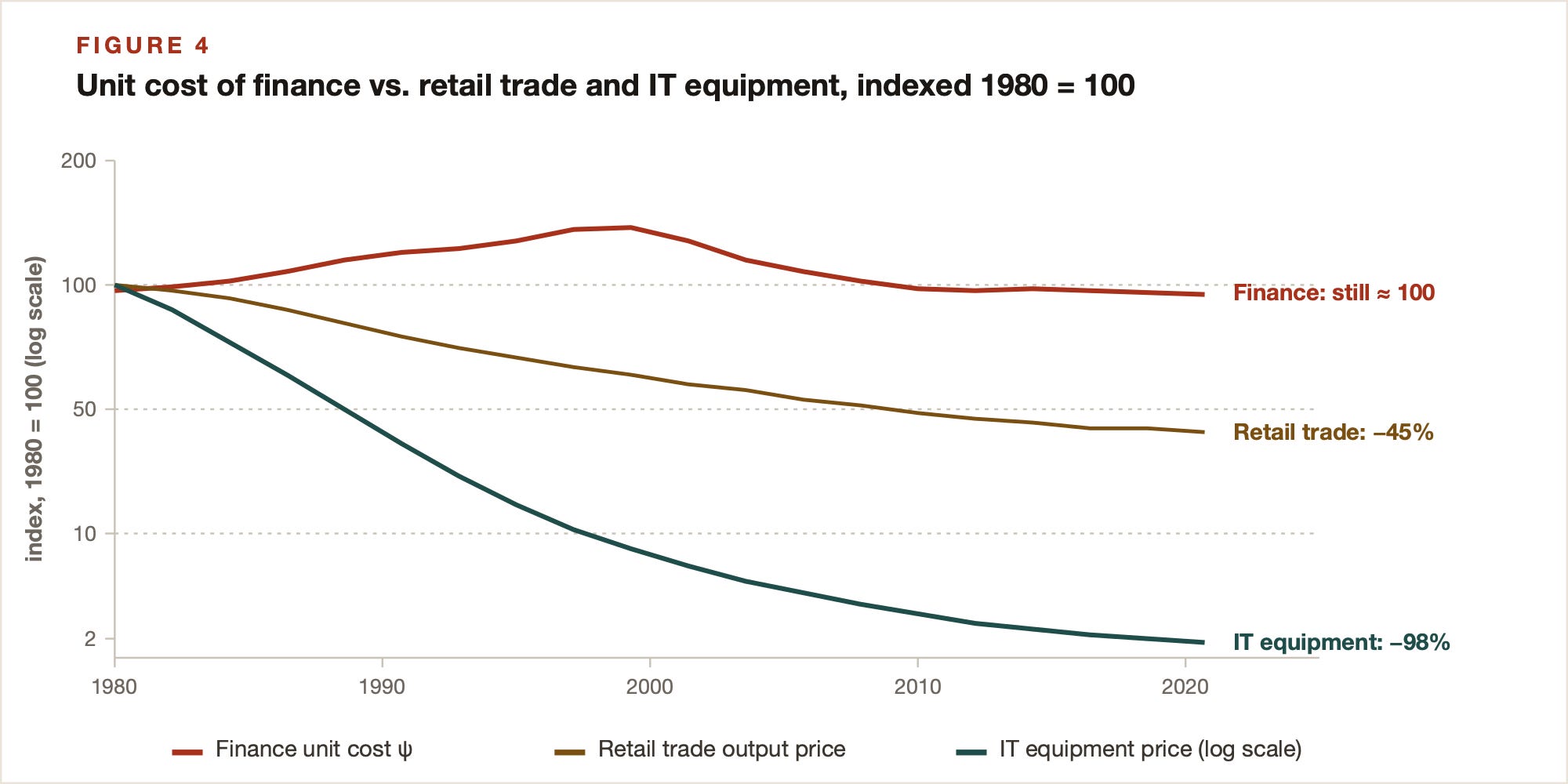
Almost every other industry that absorbed comparable IT investment got dramatically cheaper. The chart below puts ψ alongside two industries the BEA tracks where the price decline is so steep you have to plot it in logs.
Explanations for Persistent Intermediation Costs
The literature has accumulated, roughly, five serious hypotheses for why intermediation costs refuses to fall. Each is probably partially right but incomplete.
The asset-management mix shift. Individual mutual-fund and ETF fees have fallen; allocations shifted to higher-fee active and alternative managers such as hedge funds, venture capital, and private equity and credit. Average fee per dollar AUM stays flat. (Greenwood & Scharfstein, 2013.)
Trading-cost decline, volume explosion. Spreads have dropped over 90%. But volumes rose more to compensate. Active management still extracts ~0.67% of AUM attempting to beat the market (French, 2008).
Arms-race investment in expertise. Agents over-invest in expertise (think HFT infrastructure) to defend against counterparties’ opportunism. Privately rational, socially wasteful (Glode et al, 2012). Pagnotta-Philippon also notes that when exchanges compete on latency, faster venues charge more, and the rent persists.
Trust as the scarce resource. Gennaioli, Shleifer & Vishny notes that investors may be paying intermediaries for the confidence to bear risk. Trust doesn’t scale.
Information production is invisible in q. Bai et al notes that maybe finance got more efficient at producing informative prices (think the expansion of prediction markets) but that doesn’t show up in dollar quantities (i.e. financial intermediation has positive externalities).
Conclusions
The unit cost of finance appears to be one of the most stable macroeconomic constants we have. This may be because some of its proposed causes appear to be fundamental facts about human behavior.
For example, the first two causes (asset-management mix to and trading volume) both come from the desire of investors to beat the market. This does not compete away because the supply of people who believe they are above average appears to be inexhaustible. As long as there are prices, some fraction of humanity will pay to bet against them.
We should hesitate before calling this pure waste though. Since the presence of noise traders is necessary for the engine of price discovery. Measured ψ counts their fees but not the use of the information that those fees produce i.e. a positive externality the denominator q never sees.
The third hypothesis is the one place we may be hopeful, because its waste is a choice. The arms race of optimized optimal latency and microwave tower is privately rational but socially wasteful. Speed to trade redistributes who captures the information rather than producing more of it. But the size of that waste is not a constant of human nature but is rather encoded in market structure.
The same technology built for a head start under a continuous limit-order book contributes nothing extra under a frequent batch auction. Greed and self-interest are facts of human nature, but under different rules, carry wildly different social cost. The job of regulations is never to suppress competition but to shape the arena so competitive energy is spent producing information instead of shaving microseconds.
And finally, just as there will always be people who pay to beat the market, there will always be people who pay to forget it exists: to outsource the worry, to buy the ability to sleep through a drawdown. The advisor sells confidence, trust, and temperance, not insight or skill. This scrambles the tidy line between rent extraction and value creation. The wealth manager who trails the index by exactly his own fee is, on one ledger, pure rent; on another, he is selling a service his client values, i.e. the service of not having to care. Both are true at once. And the service does not get cheaper when chips do, because trust is built by reputation, personality, and time.
I nonetheless remain an optimist about the ability for the financial services industry to provide value. The deepest inefficiency in the real economy is not the two cents charged per dollar by banks and trading firms, bur rather the dollars that they never tough: the risks that no one trades because its not been securitized and the claims that cannot be collateralized because no market for it exists.
Securitize and financialize the rest of the economy and you do not lower ψ but rather enlarge q. A real economy in which more of its claims can be priced, hedged, pledged, and exchanged is a more efficient economy, even if the intermediary still keeps his cut. The per unit cost of intermediation may simply be permanent, but the territory it is levied on can still grow by orders of magnitude. That expansion may be the prize actually worth chasing. The next great financial institution will not be the one that reduces costs for investors, but rather one that create new markets of securitized assets for investors to trade.
Disclaimer
The information provided on TheLogbook (the “Substack”) is strictly for informational and educational purposes only and should not be considered as investment or financial advice. The author is not a licensed financial advisor or tax professional and is not offering any professional services through this Substack. Investing in financial markets involves substantial risk, including possible loss of principal. Past performance is not indicative of future results. The author makes no representations or warranties about the completeness, accuracy, reliability, suitability, or availability of the information provided.
This Substack may contain links to external websites not affiliated with the author, and the accuracy of information on these sites is not guaranteed. Nothing contained in this Substack constitutes a solicitation, recommendation, endorsement, or offer to buy or sell any securities or other financial instruments. Always seek the advice of a qualified financial advisor before making any investment decisions.