


From time to time we reach out to users whose onchain activity reflects the kind of trading we think everyone can learn from, and ask whether they’d be willing to walk us through their process. We never publish, share, or reveal anything about a user without their explicit permission.
The piece below is drawn from a long conversation with one such user, who generously agreed to let us write it up. All names and personally identifying details have been changed; the piece has been stylistically edited for readability; and while we trust our source, we cannot independently verify every claim he makes in the course of a day’s conversation.
Where possible, we have grounded the narrative in publicly available onchain data, and all figures in this piece are produced from public data for illustrative purposes and do NOT constitute investment, legal, tax, or any other form of professional advice.
Sea Cliff
Sea Cliff at quarter past eight on a Saturday. The fog has pulled down so low over the Pacific that the Golden Gate is more idea than bridge, you can’t see it, but you know it’s there. The hedges on El Camino del Mar are glistening with damp. In this light, the stucco houses behind them look briefly like something other than stucco; softer, almost fabric. A foghorn sounds, twice and then twice again.
Trader 12 had asked me over for coffee and pastries. He opens the door in a linen shirt, barefoot. Chemex on the counter, Arsicault croissants on a parchment-lined plate. His day job is at a venture-backed AI hedge fund downtown, the kind where the machines do the trading. Saturdays, though, are for the side gig. “On weekends, markets no longer sleep” he says, pouring two cups of coffee. “You just have to figure out what’s moving it.”
The Inference Problem
For a few dozen hours from Friday close to Monday open, Korea is dark, Japan is dark, Wall Street is dark. The only live tape on EWY, EWJ, and a handful of American chips and hyperscalers are perps onchain @HyperliquidX. Someone has to price those names to the Monday open.
“The trap most people fall into,” he says, “is to look at the S&P and then just multiply by a beta someone fit on a year of data, but that’s not how markets work.” (A beta is just a multiplier. If Broadcom’s beta to the S&P is 1.3, the rough rule says Broadcom moves 1.3% for every 1% move in the S&P. )
He sketches on a napkin. “Three prices are relatively liquid on perps over the weekend: SPX (US market), NDX (excludes financials and energy), and CL (crude oil). But those three numbers aren’t the real drivers. They’re summaries of something underneath, behind them sit what we call factors.”
“A factor is just a hidden force that moves a lot of things at once. You can’t trade it directly, you can only see it through the prices that respond to it. The reason factors are useful is that most of what happens in the world is actually explained by relatively few of them. Thousands of stocks bounce around every day. But if you take a few well-chosen forces and ask how each stock responds to each one, you can explain most of what you see. The rest is company-specific noise.”
“First factor is macroeconomic growth. How fast the world economy is actually expanding. When it’s down, everything bleeds together.”
“Second is real rates. Long-term interest rates after you subtract inflation. The companies that get hit hardest when real rates rise are the ones whose profits sit far in the future.”
“Then there’s stuff like country and sector, many smaller stories bundled together. Korean memory, Japanese autos, Taiwanese foundries, US hyperscalers. Each reacts to the same news differently. An oil spike crushes Asian manufacturers because they import almost all their energy. For US names it’s a shrug since shale made the U.S. an energy exporter.”
“There are a handful more I’m not naming. The three I just gave you make the point. The point is that there are more factors than there are liquid prices.”
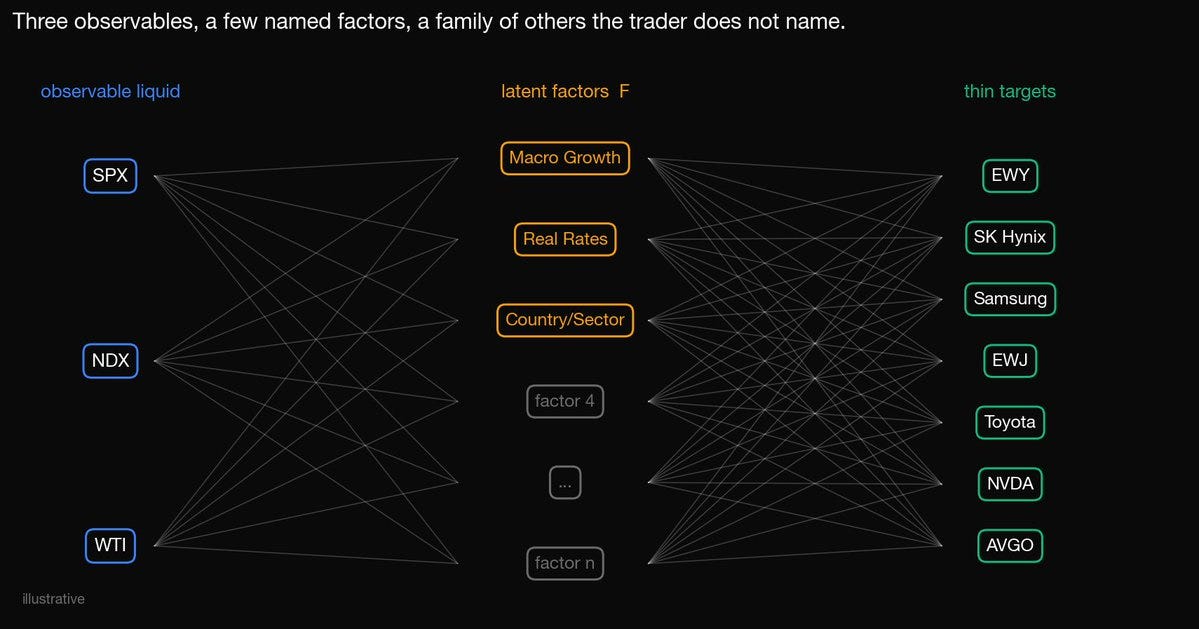
“Nonetheless, you can use the liquid tape as a constraint. SPX, NDX, and WTI trade hundreds of millions of dollars a day over weekends. Treat those three as efficient. Whatever values the factors take, they have to reproduce the liquid returns. That doesn’t pin them to one answer, but it cuts the space from infinite to a finite envelope of combinations consistent with the liquid tape.”
“Then you project that envelope onto the thin names that only trade a few million to dozens of millions a day in volume. Each combination inside the envelope implies a price for Samsung, for Hynix, for EWY. Across the whole envelope you get a range. The implicit bet is that the thin names are not efficient: Korea is closed, the perps trade thin.”
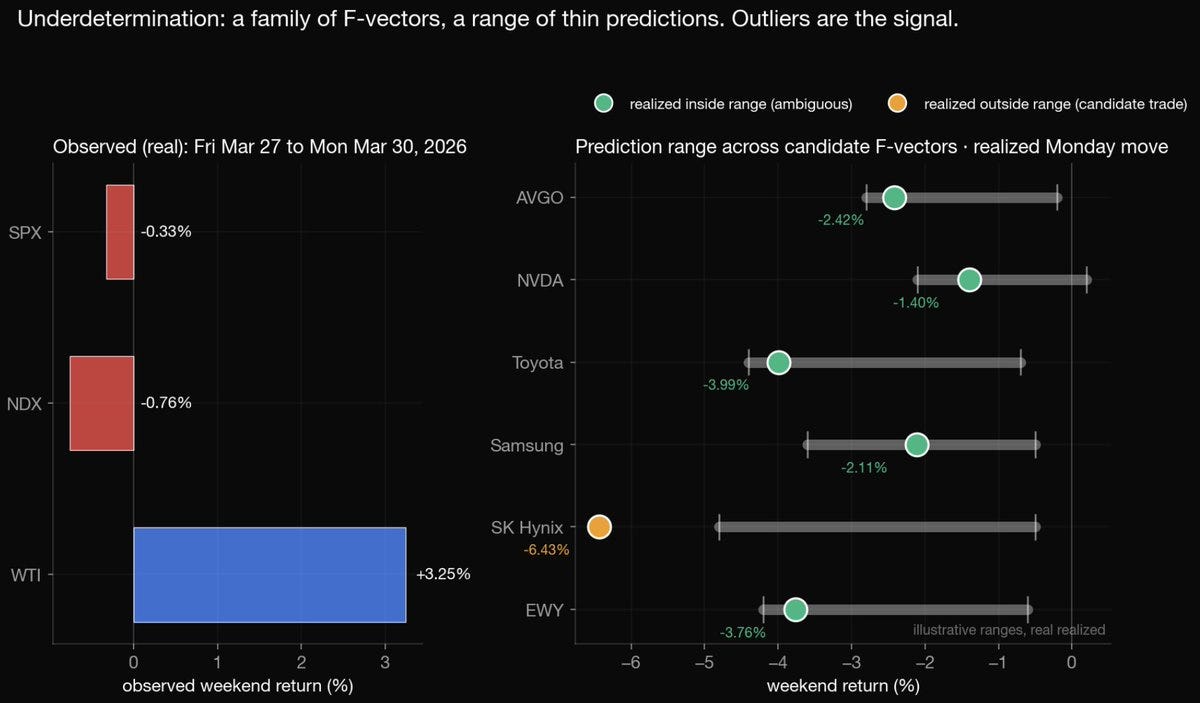
“There seems to be just one problem,” I said. “More factors than prices means many combinations of factor values can produce the same SPX, NDX, and WTI returns; and each combination, projected onto less liquid targets, like Samsung or Hynix, gives a different answer. The same liquid prints can be consistent with Samsung up two or Samsung down five, depending on which factor story is doing the work.”
“How do you decide?” I ask.
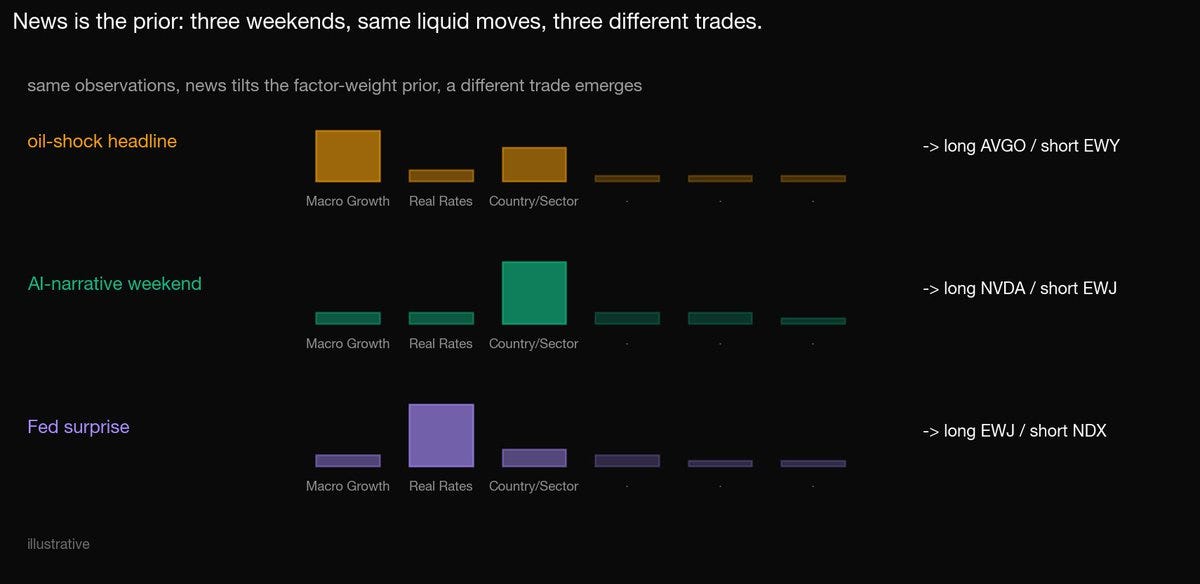
“News tells you direction. The envelope gives you magnitude. Direction without magnitude is a tweet. Magnitude without direction is noise. Both together is a trade.”
“The news being.”
“What the headline points at. An OPEC decision points at growth via oil, with importers and exporters reacting opposite directions. An Nvidia blowout points at country and sector. A Fed surprise points at real rates. The news doesn’t narrow the envelope to one answer. It tells you which corner of it the market wakes up believing.”
The Trading Problem
“In practice, the way I express a view is mechanically simple: I’m saying some less liquid symbol, Samsung, Hynix, EWJ, should move on a higher or lower beta to the liquid tape than the perp is currently pricing.”
“But the claim underneath really is about the factor drivers behind this or that particular move being different from the ones averaging into its prior. When Hormuz is the story, the relevant driver is energy intensity, and Asian importers should load harder. When earnings are the story, the relevant driver is hyperscaler capex, and memory should decouple from oil entirely.”
“The different beta is just the shadow that a different factor mix casts on the liquid axis. You’re never really betting on a coefficient; you’re betting on which factors are doing the work.“
“Let me give you some concrete examples.”
“First. The weekend the war began. Tehran and US rhetoric had been escalating all week; a strike package widely reported as imminent. The cross-section already told you who was exposed. Korea and Japan imports almost all its energy through Hormuz, the U.S. is a net exporter.”
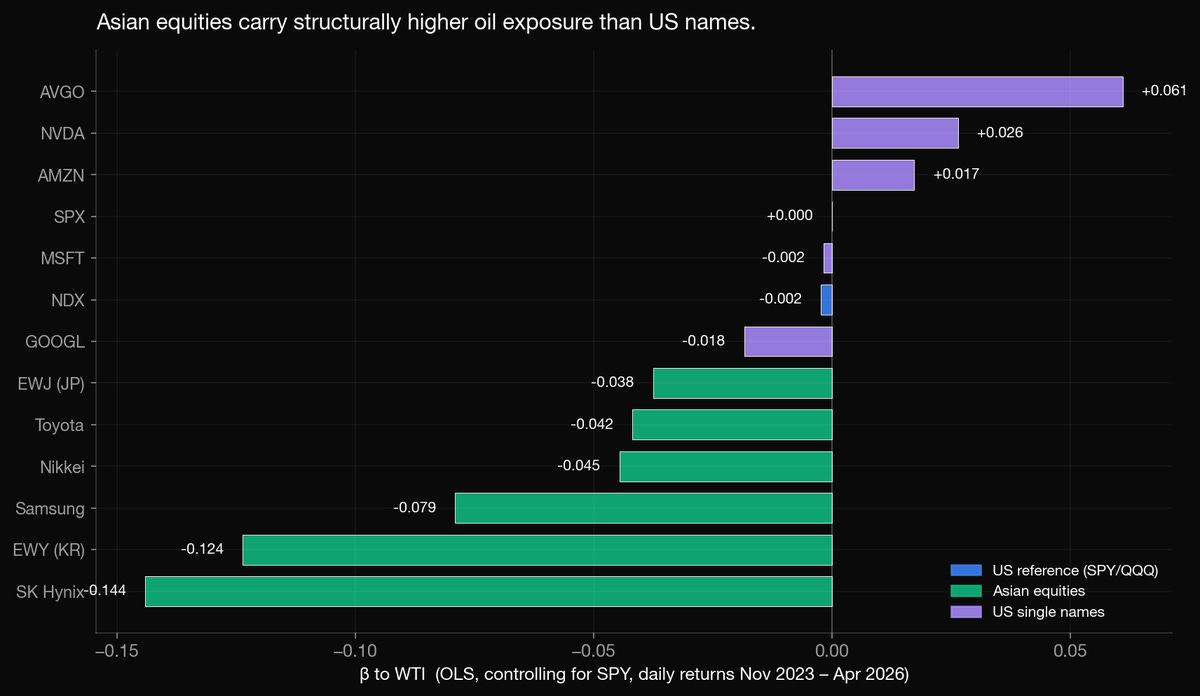
“Saturday the strike landed. Joint U.S. and Israeli operation. Oil was up onchain with SPX and NDX down sightly; but the interesting thing was that asian tickers like EWY EWJ Samsung and Hynix all traded inline with American symbols even though they had higher exposure to energy shocks.”
“The amount that the less liquid Asian symbols were down was inconsistent with how much oil was up and how much the US market was down, so I shorted all of them. On Monday, Samsung opened down nearly ten. Hynix down eleven and a half.”
“Then, earnings season started. Financials went first, the way they always do. Strong credit expansion, consumer spending holding up, capital markets activity firming. Financials are the leading indicator for the real economy because they sit at the front of every transaction.”
“The intraday correlation between the US market, especially AI-exposed names, and oil started breaking down. Memory and photonics specifically, weren’t tracking oil intraday anymore. They were trading their own factor tied to hyperscaler capex. The decorrelation persisted, day after day.”
“You’d think a correlation isn’t tradable, but it is because the way that weekend perp traders trade doesn’t seem to update as fast as the weekday market does. When bad macro news lands on a Saturday, oil rips, and the perp sells chip names down on the old beta-to-SPX, you fade it.”
“Long the chips at the perp lows. Cover Monday open. The weekday markets already knows those chips don’t load on oil the way they used to. The weekend perp traders gets there eventually. You just get there first.”
“The factors themselves don’t change. Macroeconomic growth, real rates, country and sector. What changes is how each single stock loads on each one, and that drifts faster than most people give it credit for as investor narrative shifts. The hard part is picking which factors actually matter. The principle is simple. The construction is almost all of the work.”
Land’s End
As we continued to walk, the morning fog cleared and the bridge swung into full view. He filled our coffee into red Solo cups before we left the house, the only cups he had. Pretty degenerate look for two young guys at nine in the morning. As we walk along the beach, the Pacific stretches below us. A jogger goes by. A woman with a stroller. Two old men in windbreakers. Dogs chasing each other in the surf.
“All these people,” he says. “None of them is predictable on their own. The woman with the stroller, why she’s out here and not the other side of town. The runners. The two old guys. Each one is its own thing. Each one would tell you a long story about why they’re here and not elsewhere.”
“Sure.”
“But step back. Watch a year of this trail. Watch ten years. The aggregate is structured.”
“Same as the factor model.”
“Same deal. Markets are millions of agents trading their own thing for their own reasons, and each trade is unforecastable on its own. But the covariance structure of returns, what moves with what, collapses onto five or six axes that explain most of the variance. You don’t need to know what any individual trader is doing. You just need to know how each name loads on those few axes. Same thing with people on the trail. Same thing with most aggregates of independent agents.”
“Why does it collapse like that.”
“Because the world is shaped that way. The number of underlying drivers is much smaller than the number of things they push around. The geometry is low-dimensional even when the surface looks impossibly high-dimensional. Most people only see the surface. The trade is in the geometry.”
The path curves out toward the point. We keep walking.
Disclaimer
This is an article about a conversation with a trader, not a recommendation that you do any of what he does. Nothing here constitutes investment, legal, tax, or any other professional advice. Perpetual futures carry risks that include, but are not limited to: total loss of principal, counterparty failure, protocol failure, illiquidity, and regulatory change. Past results, including the backtest figures in this piece, do not predict future outcomes.
Access to Freeport and to the venues referenced in this article may be restricted in certain jurisdictions; it is your responsibility to comply with all laws and regulations that apply to you, including those governing access to DeFi protocols and derivatives. Freeport is a non-custodial interface. We do not hold your assets, we do not take the other side of your trades, and we merely allow access to third-party venues (including Hyperliquid) which we do not operate, audit, or endorse. Every protocol surfaced through Freeport carries its own smart-contract, counterparty, oracle, bridge, and operational risk, and we make no representation as to the safety, solvency, or ongoing availability of any of them.
Any AI-generated content in the Freeport app, summaries, feeds, trade ideas, and buttons, are informational and not advisory. Surfaced actions are shortcuts, not recommendations; they reflect computed signals, not fiduciary advice, and should be treated as a starting point for your own research rather than an endpoint.