


Options theta decay in accordance with market expectations, which typically means a busy opening and closing, quiet in between, and less decay over weekends than two typical weekdays. Using a linear clock can create apparent gamma–theta and vega P&L attributions which net out in expectation. We also explore how sector-specific volatility schedules improve opening-auction valuations, how PCA can reveal their main differences, and the impact of expanded overnight and weekend trading. Examples given are with stylized and generated data and do NOT reflect the true shape of empirical data.
Intraday Seasonality in Volatility
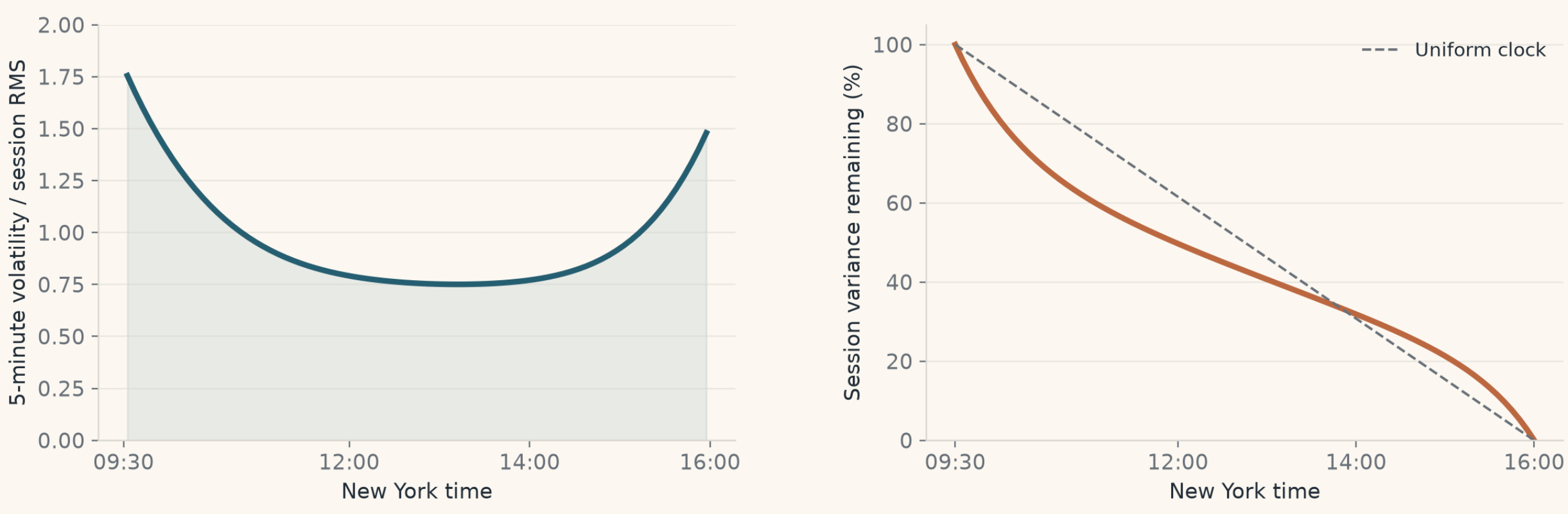
Consider an option’s extrinsic value as having a certain number of hours or days left. Those hours do not contain equal amounts of risk (i.e. historically the underlying is not be expected to move the same amount each hour over the course of the day).
Typically, stocks move more at the opening auction and shortly after, moves less during the middle of the day, and moves more towards the end of the day. This is empirically easy to verify by looking at baskets 5 minute returns.
What Happens with the Wrong Schedule?
Suppose an option expires at today’s close. At 9:30, both your model and the market assign it 100 units of remaining variance. Your model removes that variance evenly over the next 6.5 hours. The market expects a busy open, a quiet middle, and a pickup into the close.
At 10:30, say that the market has about 70 vol units left. Your linear-clock model gives 85 instead. Holding other inputs fixed, your theoretical option price is too high. To fit the lower market price using your linear clock, you must mark implied volatility down. As quiet hours pass, variance per remaining calendar minute rises into close, and the effect reverses. For delta-hedged long option, the corresponding attribution in this idealized case is shown below.
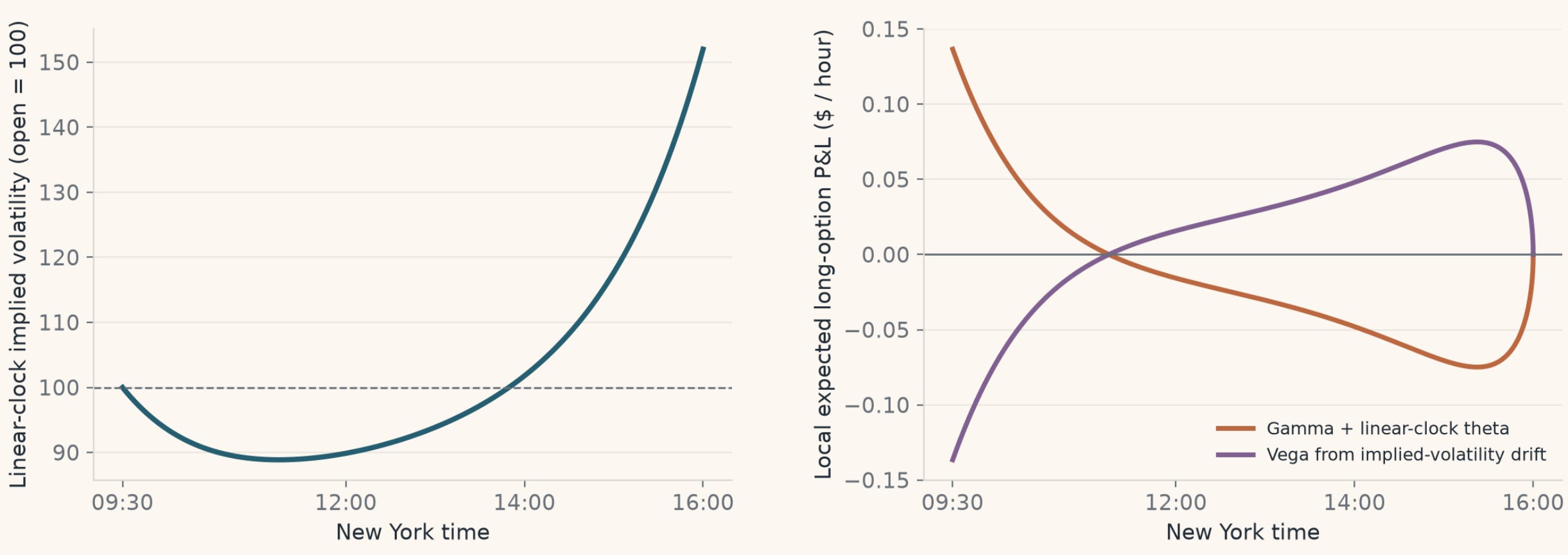
Marked to market, a long book can show vega losses and gamma–theta gains in the first part of the day, while showing gamma-theta losses alongside vega gains later in the day. With deterministic volatility, continuous hedging, and no costs, these expected attribution effects cancel locally.
Problems of course arise when you use your model to make trades instead of merely marking fair to market. An inflated theoretical value can make a fair offer look cheap, or make your bid too generous.
Weekend / Overnight Volatility Decay
During the day, most firms can reference the options mid price for some sense of fair. As such, the most direct application of model-based valuation is in the opening auction. Monday’s closing option price contains uncertainty that will be resolved before Tuesday’s option market opens.
How much volatility / time should we decay? Clearly, there is are two basic considerations we should note. First, Monday’s closing vol was informed by the realized vol and other information available on Monday; on Tuesday, we should have more information (e.g. see what the overnight realization was) which should change our posterior on the opening vol.
Second, we ought to decay the right amount of time from the option’s price. The correct overnight budget can probably be inferred from past historical data. However, this weekend decay schedule is NOT the same for all listed equities.
A domestic business might have most of its ordinary risk concentrated in U.S. hours. An Asia-linked name can absorb information while Asian markets are active. A Europe-linked name can do more of its price discovery before New York opens. A commodity ETF or ETN can respond to a related futures market that trades through much more of the day. Examples are with stylized perp data (not actual numbers).
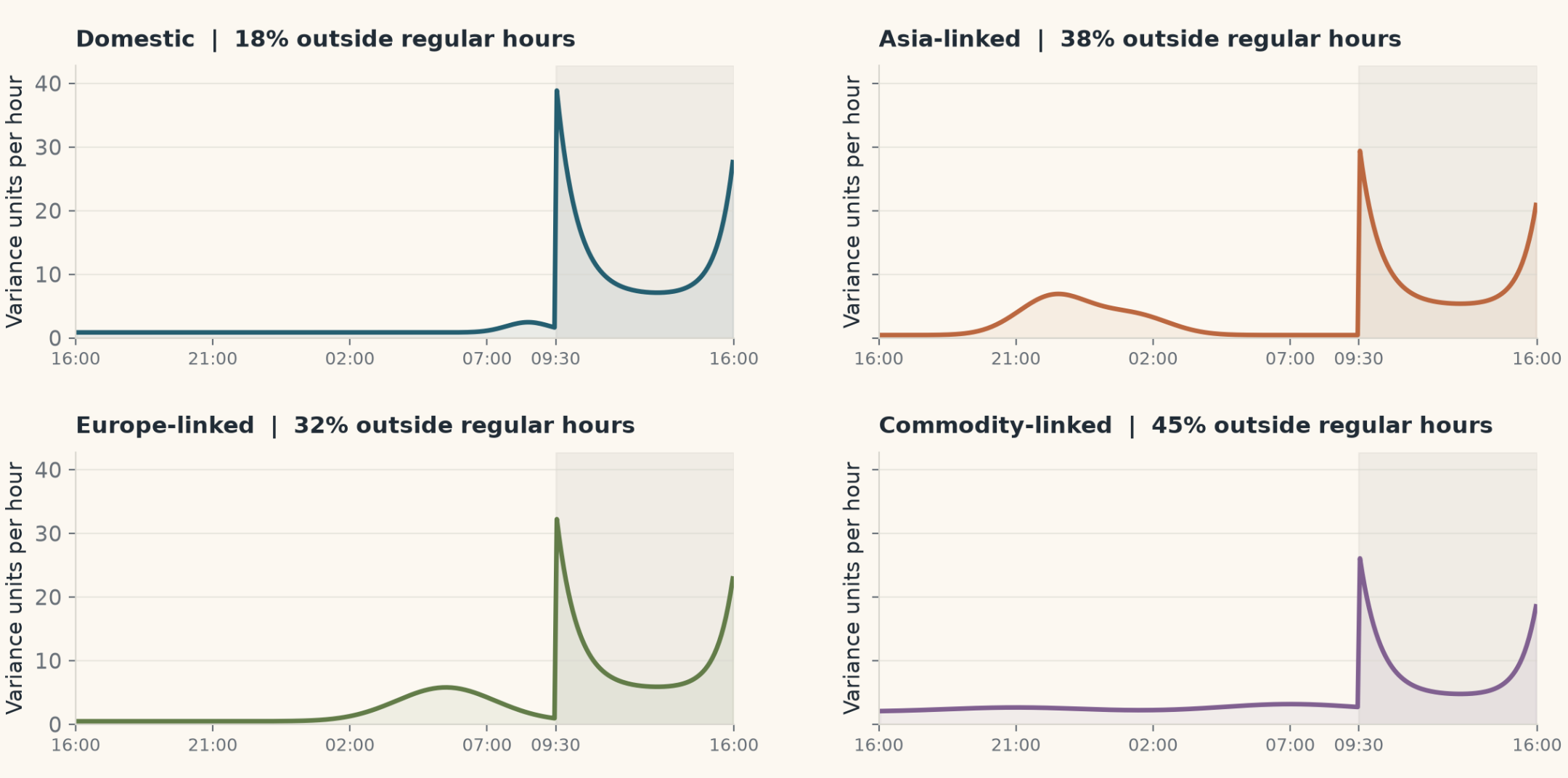
The curves outside regular hours are latent variance allocations and the observed close-to-open return compresses the intervening information into one gap. In other words, for the opening auction, more time decays for equities with exposure to Asian, European, or commodity trading hours.
A weekend / long weekends needs their own modeling also. More generally, trading and non-trading times have long been known to carry different return variances, with non-trading time roughly passing at around a third of the rate of trading time.
PCA of Decay Schedules
The choice to separate stocks into domestic / international is a bias-variance trade-off. In theory we could have more than one grouping, or even individual variance decay schedules per stock, but realized variance data is too noisy for that to be a practical choice. We can do PCA on the variance decay schedules of stocks in aggregate to estimate how much additional explanatory power is gained per additional category.
The vectors fed into the PCA are sequences of 5 minute returns, and when visualized we have a PCA of schedule shape. An unnormalized PCA will mostly distinguish high-volatility stocks from low-volatility stocks; the common U-shape belongs largely in the mean so centering removes it before PCA looks for differences. Examples are with stylized perp data (not actual numbers) with events removed.
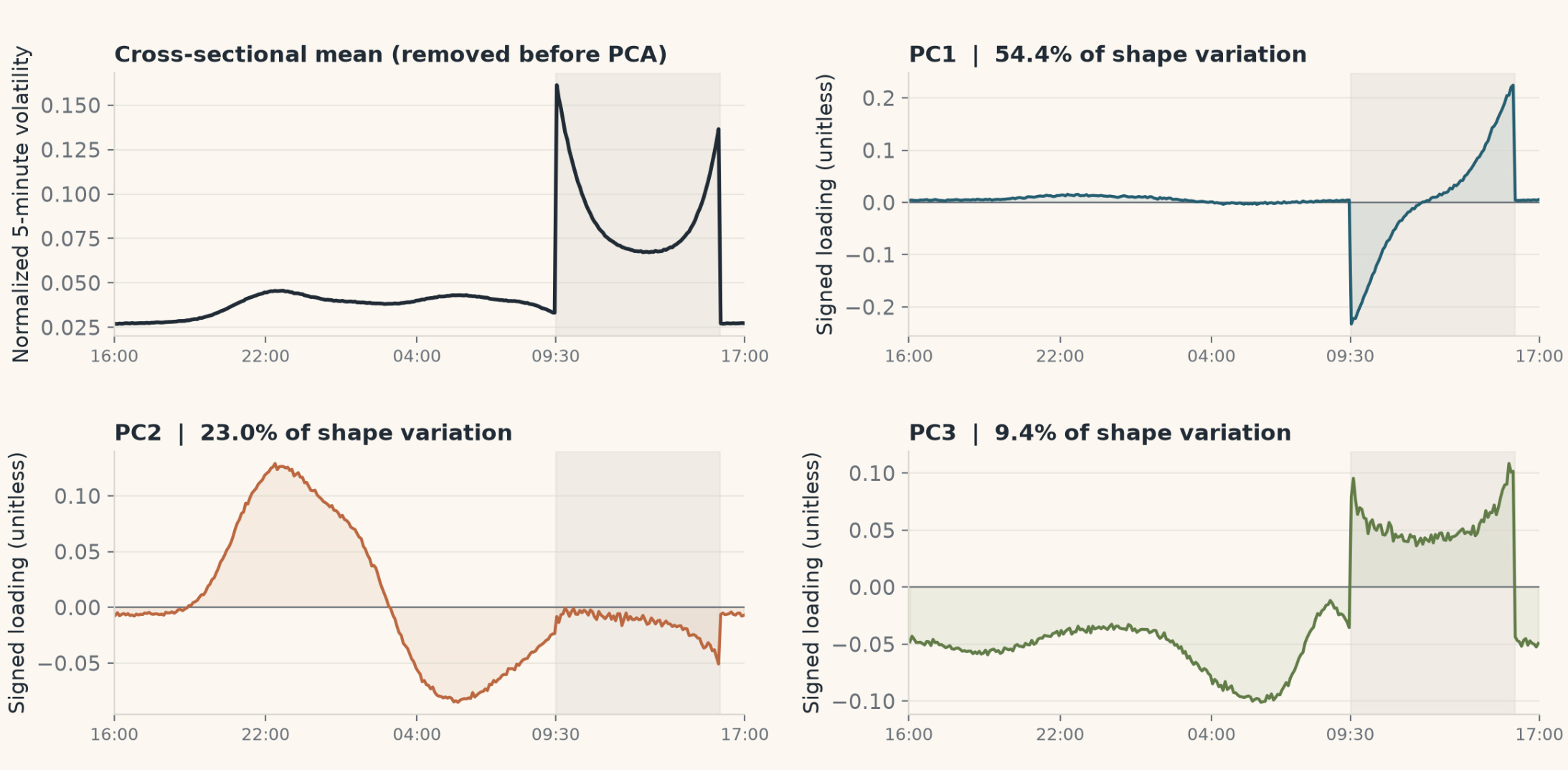
The computed components have plausible interpretations where PC1 is generally international and commodities vs domestic equities, PC2 is Asian versus European, and PC3 is stocks versus commodities. Together, they explain the vast majority of variation around the mean; i.e. few factors summarize how a stock’s variance time differs from a baseline.
Decay Schedules Change
As activity on Hyperliquid and other extended-hours venues grows, our prior is that more information will produce tradable price changes overnight and over weekends.
There are two effects that we think are plausible. First, more of the existing information flow may be priced continuously over the weekend, leaving a smaller residual gap at the next cash opening. Second, additional trading, leverage, liquidations, or fragmented liquidity may change total variance.
A dealer who assigns too little variance to newly active weekend hours can sell optionality too cheaply before that risk is realized. At Monday’s opening auction, a dealer assuming options carried uncertainty that has already resolved can overvalue them. As trading hours change, the variance decay schedule would also change.
Summary
“Time” that matters for option pricing is how much uncertainty remains before expiry. Getting the decay schedule wrong can create misleading P&L attributions and pricing errors. Decay schedules reflect when each underlying absorbs information, and a few common factors capture much of the variation across stocks. As overnight and weekend trading expands, those schedules will need to evolve with the markets they describe. Opening auctions are a place where modeling the decay schedules matter since during continuous trading firms can always mark fair to market.
Disclaimer: The information provided on TheLogbook (the “Substack”) is strictly for informational and educational purposes only and should not be considered as investment or financial advice. The author is not a licensed financial advisor or tax professional and is not offering any professional services through this Substack. Investing in financial markets involves substantial risk, including possible loss of principal. Past performance is not indicative of future results. The author makes no representations or warranties about the completeness, accuracy, reliability, suitability, or availability of the information provided.
This Substack may contain links to external websites not affiliated with the author, and the accuracy of information on these sites is not guaranteed. Nothing contained in this Substack constitutes a solicitation, recommendation, endorsement, or offer to buy or sell any securities or other financial instruments. Always seek the advice of a qualified financial advisor before making any investment decisions.