


An agentic economy could make extraordinary amounts of useful work cheap. Whether people become richer depends on what happens to the price of being human.
Stolper–Samuelson Theorem
The Stolper–Samuelson theorem connects the relative prices of goods to the real rewards paid to their inputs. In its competitive two-good, two-factor setting, a rise in the relative price of a good raises the purchasing power of the factor used relatively intensively to produce it, and lowers that of the other factor.
Greater productive capacity does not tell us which input earns more. We need to know what becomes cheap relative to what, and which inputs each activity requires.
The theorem is particularly relevant today since the promise of AI abundance contains two different propositions. One is that we will be able to produce much more; and the other is that ordinary people will be able to command much more of what is produced. Note that the second does not follow automatically from the first.
To understand the possibility of a gap, picture an agent economy trading with a human economy where they share customers and compete to supply useful outputs. In this economy, humans live on wages while agents generate revenue for whoever owns or controls them. An agent becoming more productive can possibly enlarge its owner’s income while reducing the price of a service someone else used to sell.
Worked Example
Consider two services. Routine software production uses three units of agentic execution capacity and one unit of human direction. A bespoke software engagement uses one unit of agentic execution capacity and three units of human direction.
Treat these as the recipes of existing suppliers. We are asking what happens to their input rewards when new agentic competitors change the prices they can charge. Call the rental price of agentic execution capacity r, and the price of human direction w. With competitive firms and constant returns, prices equal costs:
If both services sell for $40, each input earns $10 per unit. Solving the equations gives:
Suppose agent supply makes routine software 20% cheaper, taking its price to $32, while the bespoke service stays at $40. The equations give r=7 and w=11. The rental per unit of execution capacity falls 30%; the price of human direction rises 10%.
Cheap execution has made the remaining human contribution relatively valuable. Someone selling that contribution earns more and buys cheaper software.
But suppose agents instead make the bespoke service 20% cheaper while routine software stays at $40. The equations give r=11 and w=7. Human direction now earns 30% less, and even the service that became cheaper has fallen in price less than the human input’s pay.
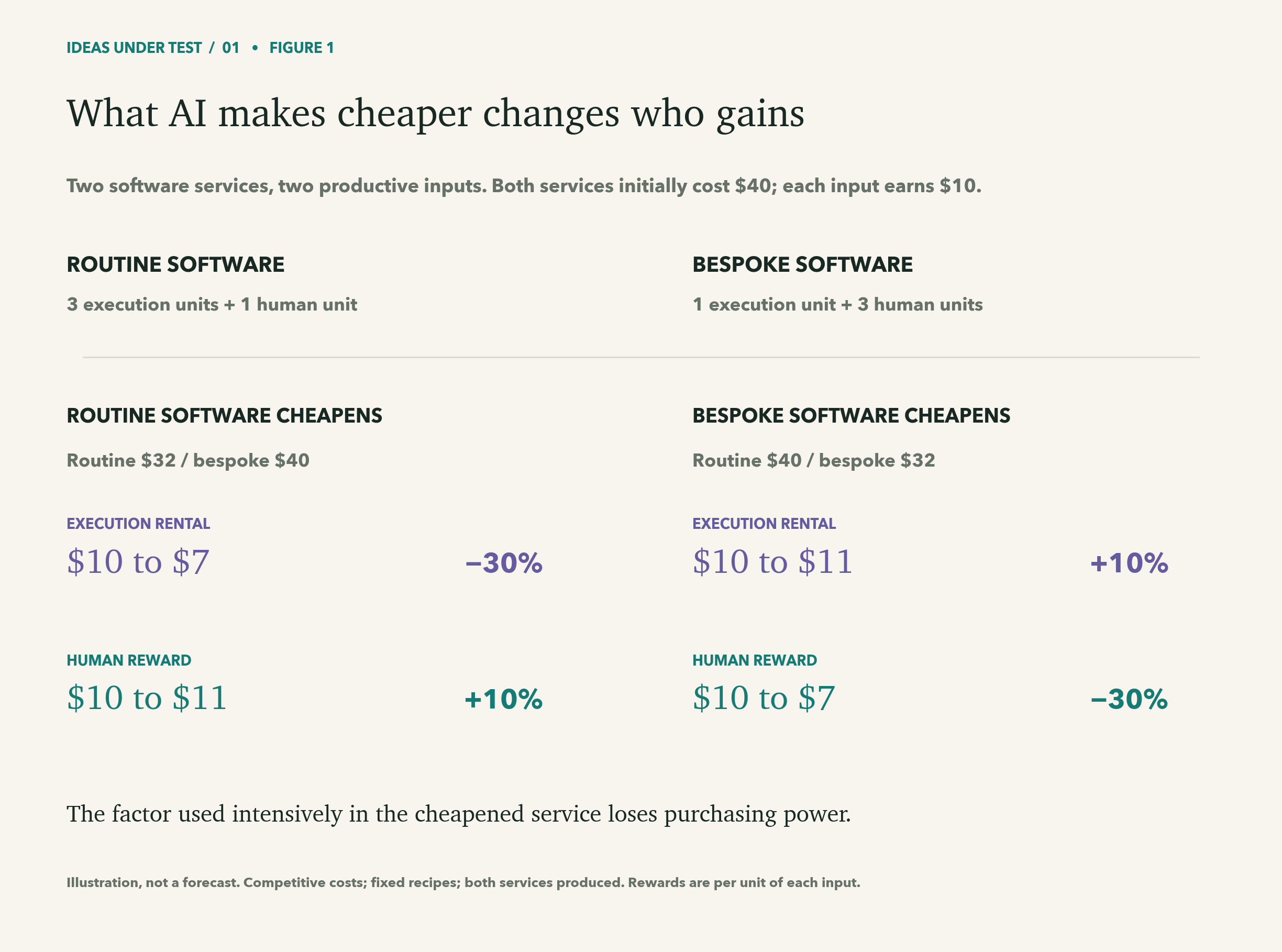
This is the mathematical structure behind Stolper–Samuelson. AI can cheapen the things humans buy, the things humans sell, or both.
Scarcity Captures Abundance
Tokens are not automatically the source of economic power; they are merely an output. Producing them uses other inputs, and the rewards flow toward whatever remains valuable and difficult to expand (i.e. a “bottleneck”): perhaps it could be compute, but it could also be electricity, distribution, intellectual property, customer access, or human taste and judgment.
Human judgment is not a guaranteed refuge. It pays more in our first example ONLY because it remains needed while execution becomes cheaper. If agents substitute for that judgment, we must solve a different model.
The model also contains a specific human contribution, not the median citizen. A person whose routine work competes with cheap execution may lose income while another person becomes more valuable directing the output. To predict both groups’ earnings, we would need to distinguish routine labor, valued direction, and capital separately a system of equations.
Comparative Advantage
Suppose a human can produce one standard code module or resolve one difficult bug in an hour. An AI system, using a fixed budget of execution capacity, can produce ten modules or resolve two bugs. Assume the outputs are comparable in quality.
The AI is better at both. But a bug fix costs the human one forgone module; it costs the AI five. The human has a comparative advantage in debugging because their relative disadvantage is smaller there.
An exchange of one bug fix for two modules benefits both.
The human receives two modules for work that would otherwise cost them the opportunity to produce one. The AI obtains a bug fix by producing two modules rather than sacrificing five modules to do the debugging itself.
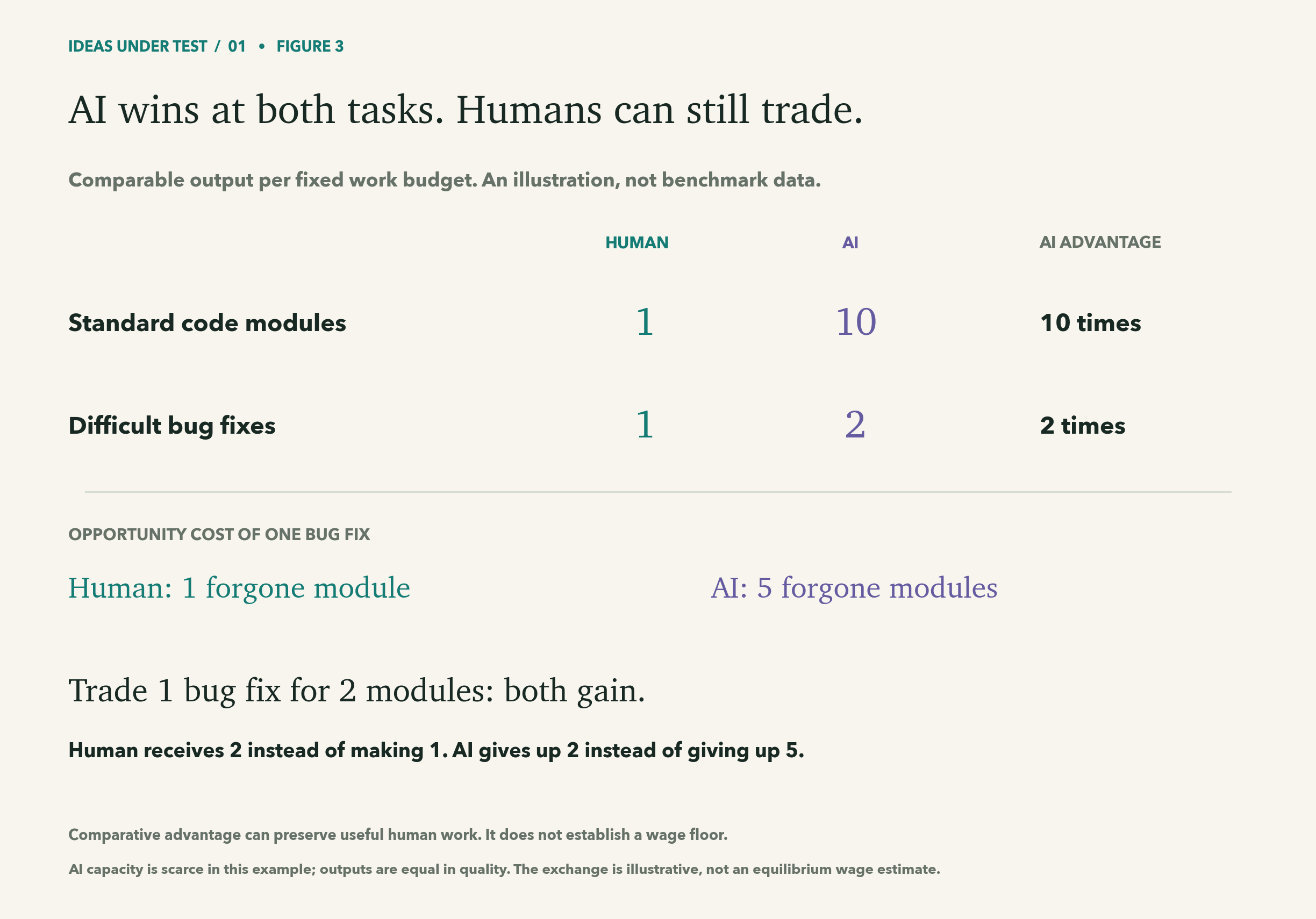
Human usefulness can therefore survive AI’s superiority. What this does not establish is a comfortable wage. The price of a person’s contribution depends on demand, competing workers and the cost of the AI alternative. If scalable agents can supply every relevant task at negligible cost, the scarcity supporting that price can disappear.
Comparative advantage helps explain what humans and AI might each specialize in, even if AI is more productive at every task. Stolper–Samuelson asks who gains and who loses from the resulting changes in relative prices.
The first concerns the division of work between the human and agent economies; the second concerns the distribution of income within each economy, through changes in wages and returns to capital. Together, they explain why producing more abundance and sharing in that abundance are two different economic questions.
Purchasing Power
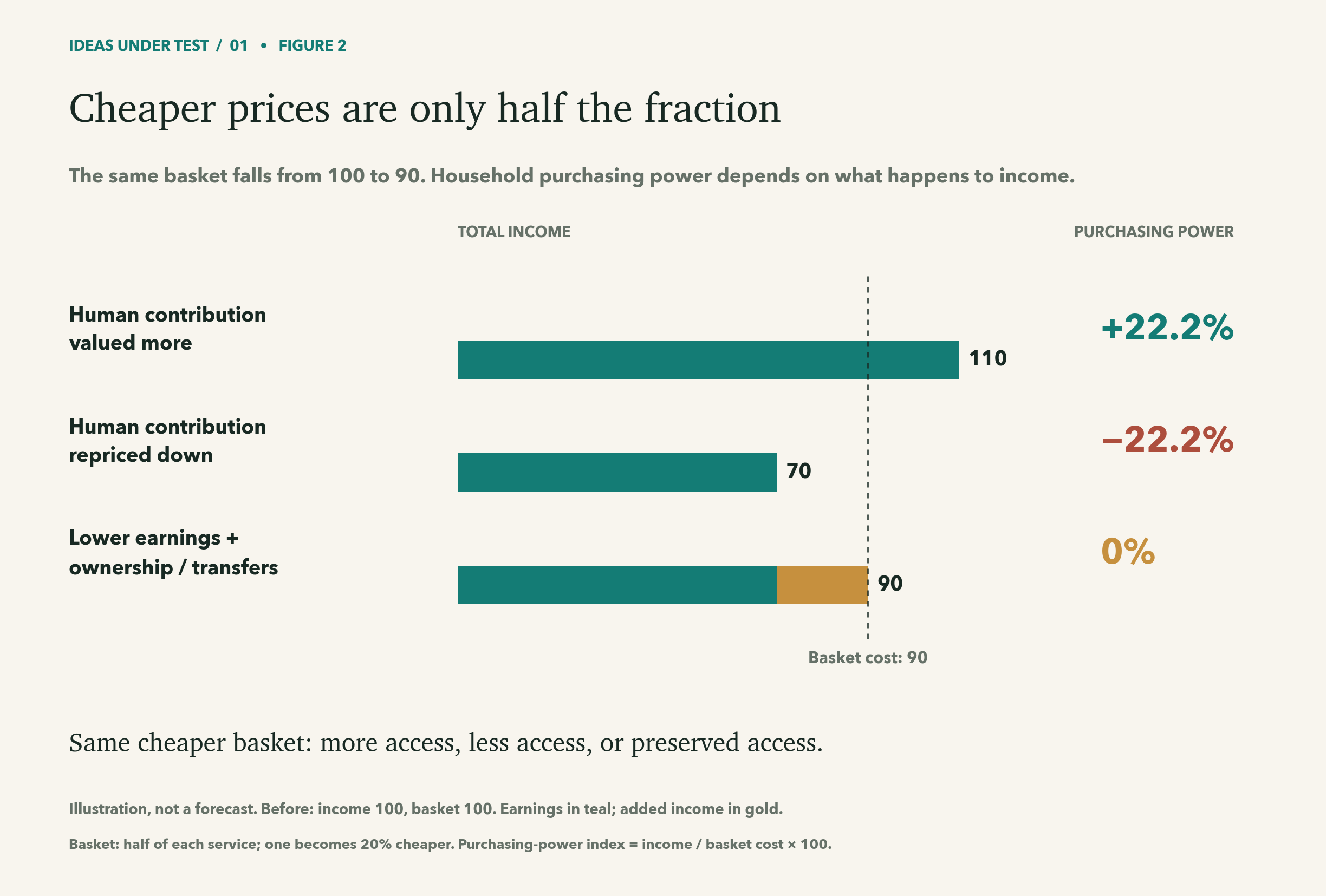
A person’s access to abundance depends on their total income relative to the cost of what they need:
Suppose a fixed basket initially costs $100, split equally between our two services. A 20% decline in either service lowers the basket’s cost to $90. If your income rises from $100 to $110, you can buy 22% more baskets. If it falls to $70, you can buy 22% fewer. The cheaper basket is identical in both cases. A $20 dividend or net transfer via government would bring the second household back to $90 of income, enough to preserve its previous purchasing power.
Detroit or Shenzhen
Most people in the developed world do not yet know whether to imagine themselves as Detroit workers, undercut by a new producer, or Shenzhen workers, finding a valuable position in a much larger production system.
Consensus expectation is that AI will first compress the value of repeatable digital work and that replacement may proceed more slowly where work involves unpredictable physical environments, difficult relationships or responsibility people insist on assigning to humans.
Agency may matter more, in addition to having customer relationships, capital, network, and being in a position to decide what gets built. Someone directing cheap execution could become far more productive while someone selling that execution earns less. The divide may run through the human economy itself.
Ownership of diversified productive capital makes for an attractive hedge against depending entirely on labor income. However,“own capital” cannot be the entire social answer when many people lack the resources to acquire it.
If labor ceases to provide reliable access to prosperity for much of humanity, a theory of distributive justice defined only by existing property rights becomes harder to reconcile with human flourishing. That would strengthen the case for a universal high income or broader public participation in capital returns.
Disclaimer: The information provided on TheLogbook (the “Substack”) is strictly for informational and educational purposes only and should not be considered as investment or financial advice. The author is not a licensed financial advisor or tax professional and is not offering any professional services through this Substack. Investing in financial markets involves substantial risk, including possible loss of principal. Past performance is not indicative of future results. The author makes no representations or warranties about the completeness, accuracy, reliability, suitability, or availability of the information provided.
This Substack may contain links to external websites not affiliated with the author, and the accuracy of information on these sites is not guaranteed. Nothing contained in this Substack constitutes a solicitation, recommendation, endorsement, or offer to buy or sell any securities or other financial instruments. Always seek the advice of a qualified financial advisor before making any investment decisions.