

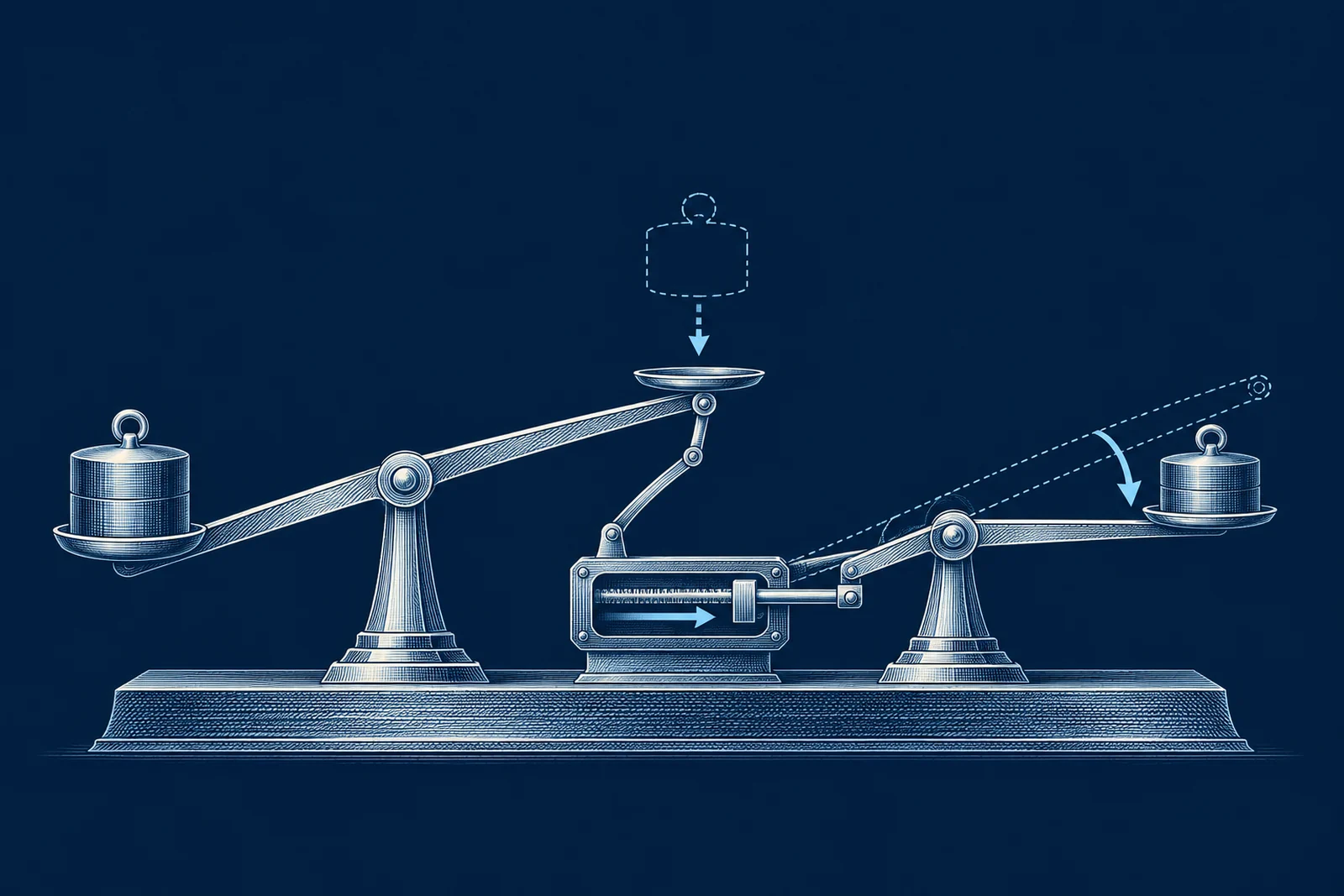
Liquidation is familiar: a losing account runs short of collateral and the venue reduces its position. Auto-deleveraging, usually shortened to ADL, addresses a different problem. If a failing account cannot cover what it owes, the venue may close part of a profitable position on the opposite side.
That makes ADL especially important for hedged portfolios. A trade can be profitable and still cease to provide the protection it was opened to provide.
Why closing a losing account may not be enough
Consider a rapidly falling market. A leveraged long is liquidated, but buyers are scarce and the position cannot be closed before its losses exceed the collateral supporting it. Someone still has to absorb or settle that exposure.
Venues use different arrangements: ordinary liquidation orders, insurance or backstop capital, position transfers and, in some designs, ADL. The sequence and who bears the remaining loss are contract rules, not universal properties of perpetual futures.
Hyperliquid’s liquidation process first attempts order-book execution and can then transfer a failing position to its backstop. Its ADL rules describe a further response when an account or isolated position has negative value: profitable opposite-side positions can be selected for reduction, with ranking based on profit and leverage. That is a specific venue design, not a promise about every market called a perp.
The surviving exposure is the real issue
Suppose you own 10 units of an asset and hold a short perp for 10 matching units. Ignoring basis changes, costs and contract differences, a $1 fall loses $10 on the asset and gains $10 on the short. The net price exposure is approximately zero.
Now an ADL event closes four units of the profitable short. You still own 10 units, but only six remain short. Your portfolio is now net long four units.
If price is $70, that is $280 of net long exposure. A further $5 fall costs the combined portfolio approximately $20. The earlier gain on the four closed short units was real; it simply does not hedge the next move.
This is why monitoring only account equity can miss the problem. Equity may look healthy at the instant of ADL, while the relationship between two legs has changed. Positions, recent forced fills and hedge quantities need to be reconciled together.
Closing price and ranking matter
An ADL fill follows the venue’s specified mechanism. Hyperliquid closes selected positions at the previous mark price; another venue may specify a different method. It need not be the order or exit price you chose. A trader should know how positions are ranked, what price is used and whether a reduction can be partial. A warning indicator is useful only if you understand what it ranks.
Adding collateral might affect a leverage-based ranking under some rules, but it is not a general guarantee against ADL. Nor does using isolated margin automatically remove the opposite-side reduction mechanism. The relevant question is how that particular contract handles insolvency.
A displayed profit also says little about the economic purpose of the position. The exchange can see its own contract; it may not see the asset, option or exposure that the position hedges elsewhere.
Restoring the hedge
After a reduction, first confirm the actual remaining position. Then compare the available choices: rebuild the short, reduce the underlying asset, use another sufficiently matched hedge or consciously retain the new directional exposure.
Each choice has a cost. Reopening the short during stressed trading can be expensive or unavailable. Selling the asset may be constrained by a closed market. A different instrument introduces basis risk, meaning the two prices may no longer move together closely enough.
In the example, the account must either replace four short units or reduce four units of the asset to restore the original hedge. Until then, it is carrying a directional position, even if the trading screen still shows a profit on the short.