

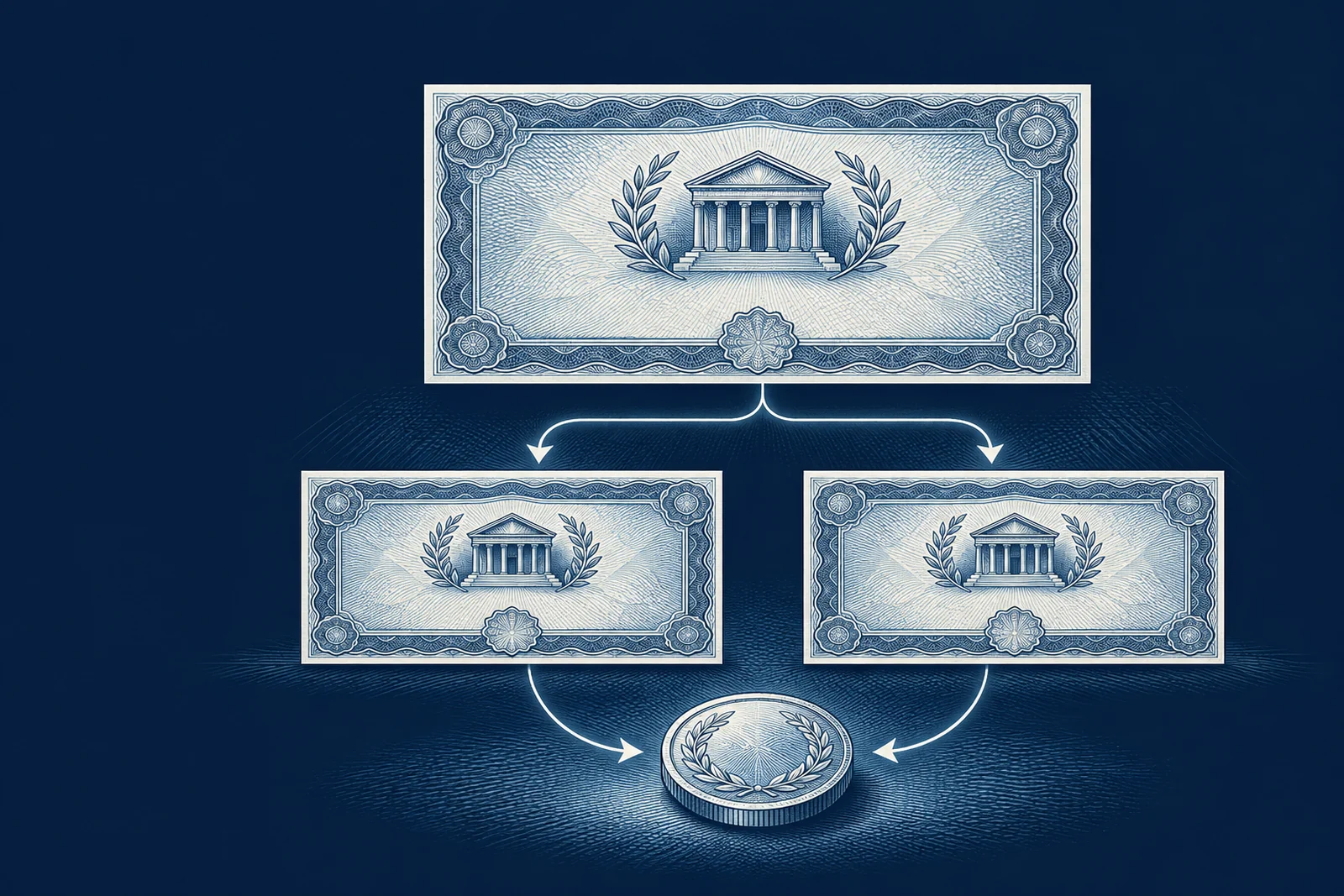
A stock falling from $80 to $40 usually looks alarming. If each old share became two new shares overnight, nothing was lost through the split itself. The price changed because the unit changed.
Corporate actions require that same accounting habit: follow the number of shares, the cash received or paid, and any new claims. The change in the displayed price is only one component.
A split changes units
Before a two-for-one split, 100 shares at $80 are worth $8,000. Afterward, 200 shares at a theoretical $40 are worth the same $8,000. Earnings per share and other per-share comparisons need the same adjustment.
A reverse split moves in the opposite direction: fewer shares, each representing more of the same business. Neither operation by itself creates value. The SEC's stock-split explanation distinguishes a split from issuing additional ownership to new investors.
NVIDIA's 2024 split FAQ provides an issuer example: shareholders retained the same proportional interest after its ten-for-one split. Subsequent market movements were separate from that arithmetic.
A dividend moves cash out of the company
Suppose a stock is worth $80 before a $2 cash dividend. Ignoring other news, taxes, and market frictions, the business is worth $2 less per share after distributing that cash. A theoretical $78 share plus $2 cash preserves the original $80 of wealth.
The ex-dividend date determines whether a purchase carries the entitlement under the applicable rules. It is different from the payment date. The SEC's dividend-date guide also notes special cases, so do not infer entitlement simply from a date labeled “record.”
Buying just before the ex-date does not make the distribution free profit. You acquire the entitlement as part of what you pay for. The actual opening price can move for many other reasons, which is why the adjustment is an economic baseline rather than an exact forecast.
New issuance changes ownership
Now consider a company worth $5,000 with 100 shares at $50. It issues 50 new shares at $40, bringing in $2,000. If the transaction adds only that cash and changes nothing else, the combined value is $7,000 across 150 shares, or about $46.67 each.
The old shareholders own a smaller percentage of a larger cash balance. Because the new shares were sold below the original per-share value in this simplified example, value shifts toward the buyers. A rights offering may give existing holders an entitlement intended to address that allocation; its terms and any cost to exercise matter.
The lesson is to track both the new money and the new share count. “More shares” does not describe the same event in a split and a financing.
Spin-offs and takeovers change the package
After a spin-off, an investor may hold shares in both the parent and a separated business. Looking only at the parent's lower price omits the new holding. A takeover may exchange the old shares for cash, another company's shares, or a mixture, subject to the announced conditions.
Reconcile the account against the issuer's terms: quantities, cash, fractional-share treatment, and timing. A broker's display can update different components at different times, creating temporary-looking gains or losses that are really incomplete accounting.
Price return and total return
If you buy at $80, receive a $2 dividend, and sell at $82, the gross total gain is $4, or 5%. The price-only gain is 2.5%. Comparing the latter with a reinvested-dividend benchmark understates the result.
Historical charts may adjust for splits, distributions, or both. A backtest must keep prices and quantities consistent; an adjusted historical price should not accidentally receive the same dividend a second time.
Derivatives and tokenized instruments require an additional check. Their treatment of a dividend, split, or merger comes from the contract's adjustment rules, not merely from sharing the company's ticker. Establish what changed in the full claim before deciding that a chart move represents an investment gain or loss.